updated 12/18/2025
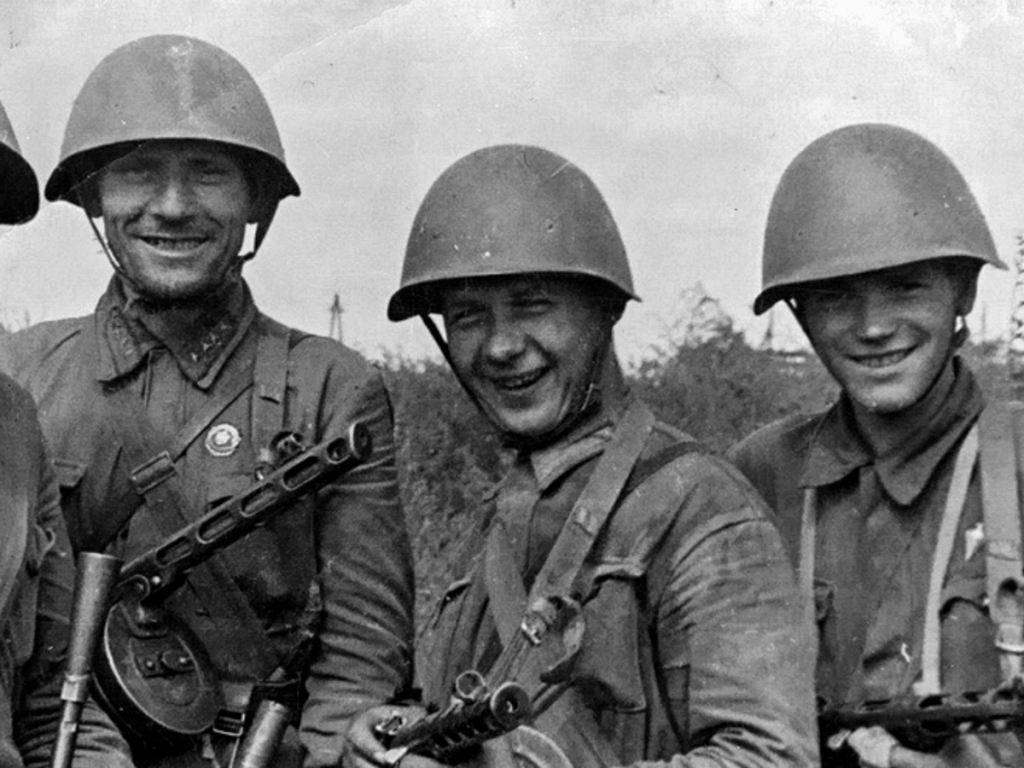
General Information: The SSh-40[1] was the most widely used helmet in the history of the Red Army and was the basic helmet of the Soviet soldier in the Second World War. It was an improvement over the previous model, the SSh-39. Externally the helmets were nearly identical, but the SSh-40 had a liner system that could accommodate the use of regulation winter headgear under the helmet, particularly the budenovka. This addressed a significant deficiency of the previous model which could not easily be used together with a cap or other head covering. [2] The main external difference between the SSh-39 and SSh-40 was that the former has three rivets for securing the liner, while the latter had six rivets located lower down for attaching the improved liner.
Following a test period that started at the end of 1940, mass production of the SSh-40 started in mid-1941 at two factories: the Lysva metallurgical factory and the Red October metallurgical factory in Stalingrad. The Red October factory produced 2,673,400 SSh-40 helmets before production ceased in the fourth quarter of 1942[3] due to the German army advance on Stalingrad. By war’s end the Lysva factory had produced more than 10,000,000 SSh-40 helmets. [4]
The three liner pads on the SSh-40s were made of a rubberized canvas material called “gralek.” The gralek material in wartime produced SSh-40s most often had a texture made of geometric patterns although some were smooth textured. The chinstraps on the early production SSh-40s made in 1942 were like those found on SSh-39. These were made of khaki colored webbing material with horseshoe shaped metal tips at the end of the long section. Starting towards the end of 1942 the Soviets used an undyed white cotton material for chinstraps that lacked the metal reinforcement tips.[5]
They Lysva produced helmets had a small five-point star logo pressed into the metal of the visor to indicate that the helmet batch had passed a ballistics test. The Red October factory helmets lacked this feature. Both factories had black ink stamps with numbers and letters within a rectangular border. These stamps indicated three things: the helmet size, the manufacturing facility, and the date of manufacture. Within the rectangle at the top was the word “POCT,” later shortened to just “P” for helmets made by the Lysva plant, followed by a number 1, 2, or 3. The word “POCT” means “size” in Russian. Below that is a factory code. The Red October factory used the acronym “ЗКО” (ZKO) as their factory code. The Lysva factory initially used the three-letter acronym ЛМЗ (LMZ) meaning Лысьвенский металлургический завод (Lysva Metallurgical Factory). Later this was shortened to just the single letter Л. After the factory identification is a two-digit number (for Lysva) or a four-digit number (for Red October) representing the year of manufacture. Helmets made at the Red October facility in 1942 had dates stamped outside the rectangle. These were three letter abbreviations followed by four digits representing the month and year of manufacture, respectively.
The helmets also had a two to four-digit number ink stamps. Often referred to by collectors as a “workshop number,” these were batch numbers used for quality control. On the Lysva helmets these appeared adjacent to and to the left of the manufacturer’s stamp in 1942. In later production the workshop numbers are on the side of the helmets. For helmets from Red October, these stamps usually appeared at the back of the helmet opposite the manufacturer’s stamp.[6] Above the workshop numbers may be found a military quartermaster’s stamp. These were two or three digits within a five-point star within a circle. These star stamps indicated that the helmet met quality control criteria. [7]
Helmets from both factories had the size of the helmet (1-3, small to large) stamped into the metal. Following this was steel batch number. These batch numbers were occasionally reset, so cannot be used to date the helmets. The size and batch numbers for Lysva were misaligned while the ones for Red October were aligned. The production percentages by size were as follows:[8]
Size 1: 50%
Size 2: 47%
Size 3: 4%
The SSh-40 remained in service for decades after WWII. The Lysva factory restarted SSh-40 production in 1947 and then stopped in 1948.[9] Beginning in 1950, the reconstructed Red October plant in Stalingrad initiated manufacture of newly pressed SSh-40s and production of these helmets continued until the introduction of the SSh-60. The SSh-60 had the same shape as the SSh-39s and SSh-40s, but rivet system was different. It had four rivets at the top and one on each side just above the ear sections.
The Soviets refurbished most of the surviving Second World War SSh-40s in the early postwar period. The Lysva metallurgical factory performed this work.[10] The refurbishments involved replacing the old liners and chinstraps and repainting the shells. Initially Lysva used stocks of gralek material left over from WWII for the liners.[11] When these stocks were exhausted, they used newly produced gralek material. The newer gralek cloth differed from the wartime material in that it lacked the geometric patterns and instead had a smooth or slightly pebbled finish. This is one way that collectors distinguish between wartime and postwar manufactured liners. Another quick identifier of postwar refurbished and postwar manufactured helmets are the chinstraps. Postwar chinstraps were like the ones used on the SSh-39s and earliest production SSh-40s with khaki colored webbing and metal reinforced chinstrap ends.[12] The helmets that Lysva refitted had black stamps with numbers and letters within a black border like the wartime manufacturer stamps, but with a large “P” stamp on the left side representing the Russian word for “refurbished.” These stampings included the new Lysva logo which looked like a upside down “V” imposed over an upside down “W.” Collectors refer to this stamp, introduced in 1948, as “the spider.”[13] Like the helmets made during the Second World War, the helmet size along with the date of refurbishment is given.
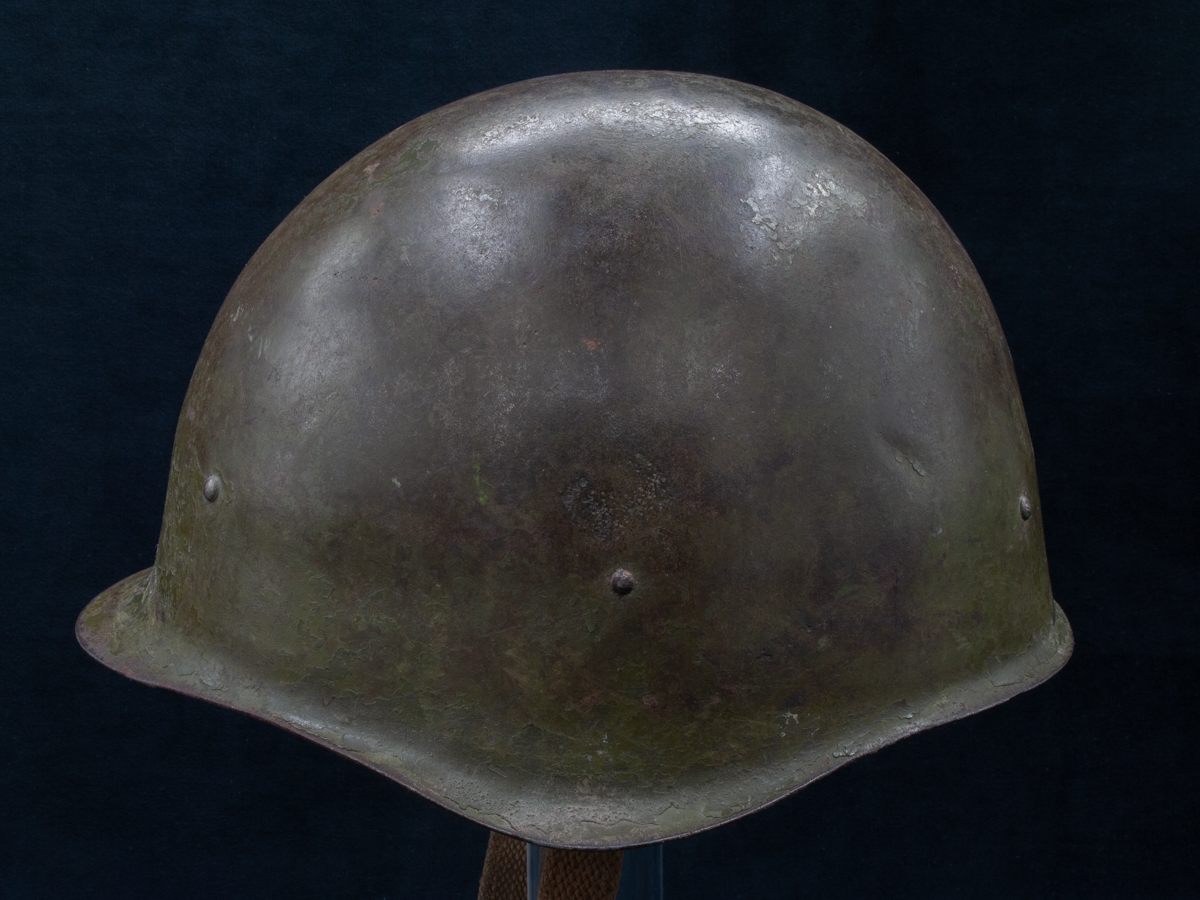
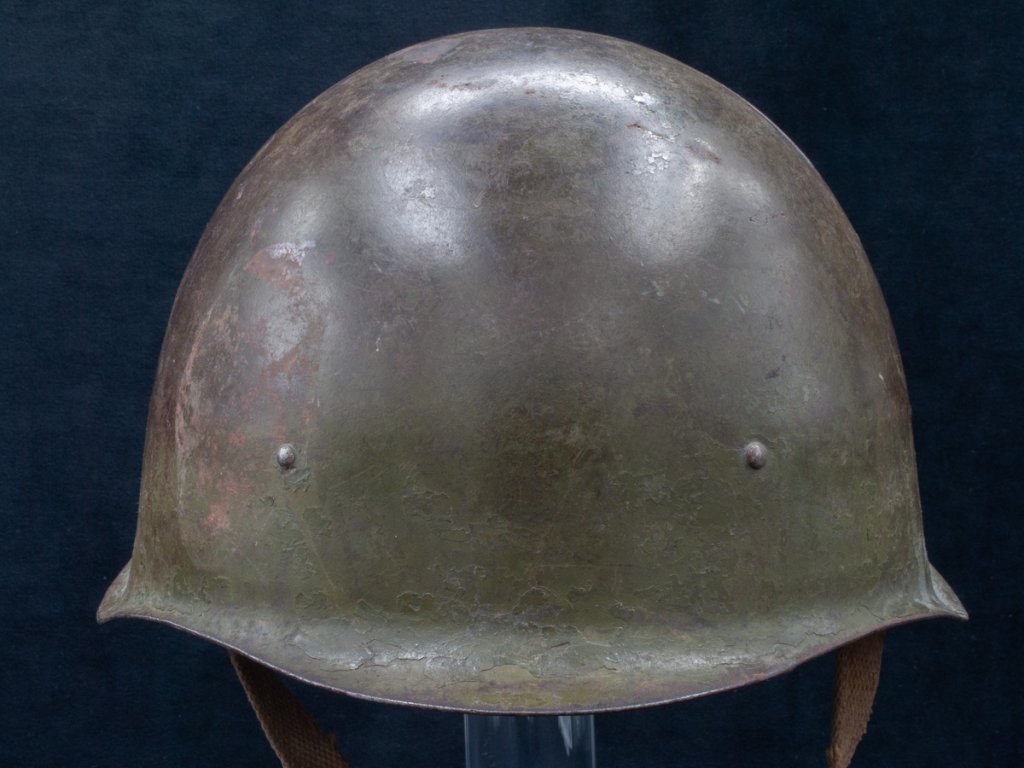
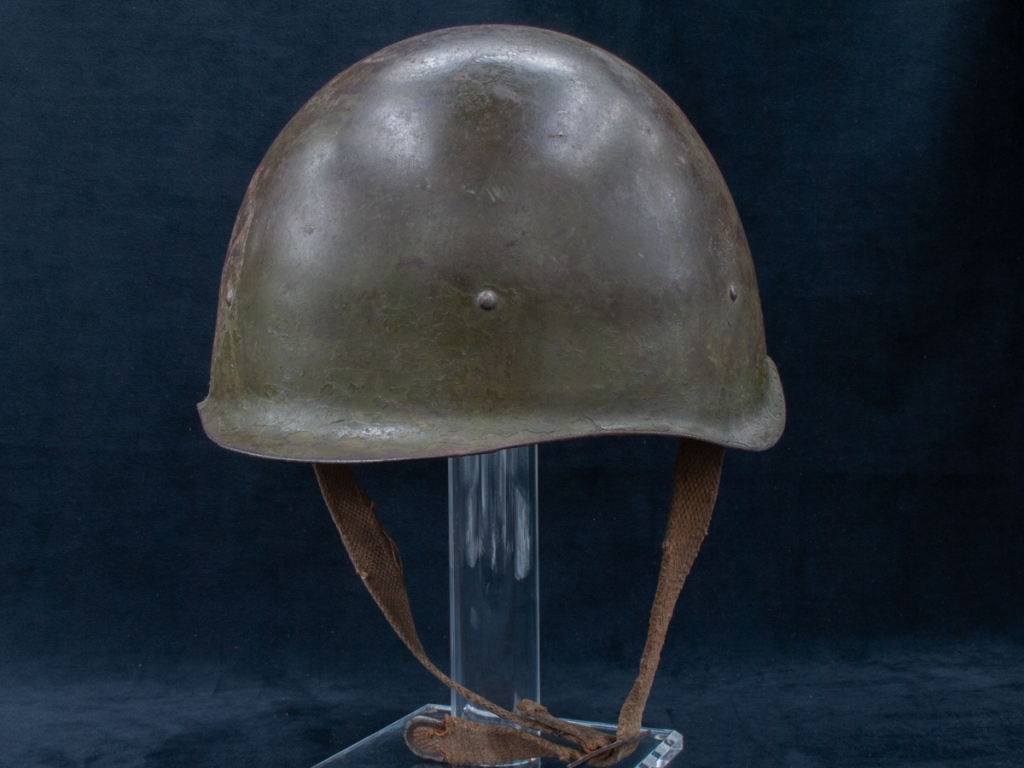
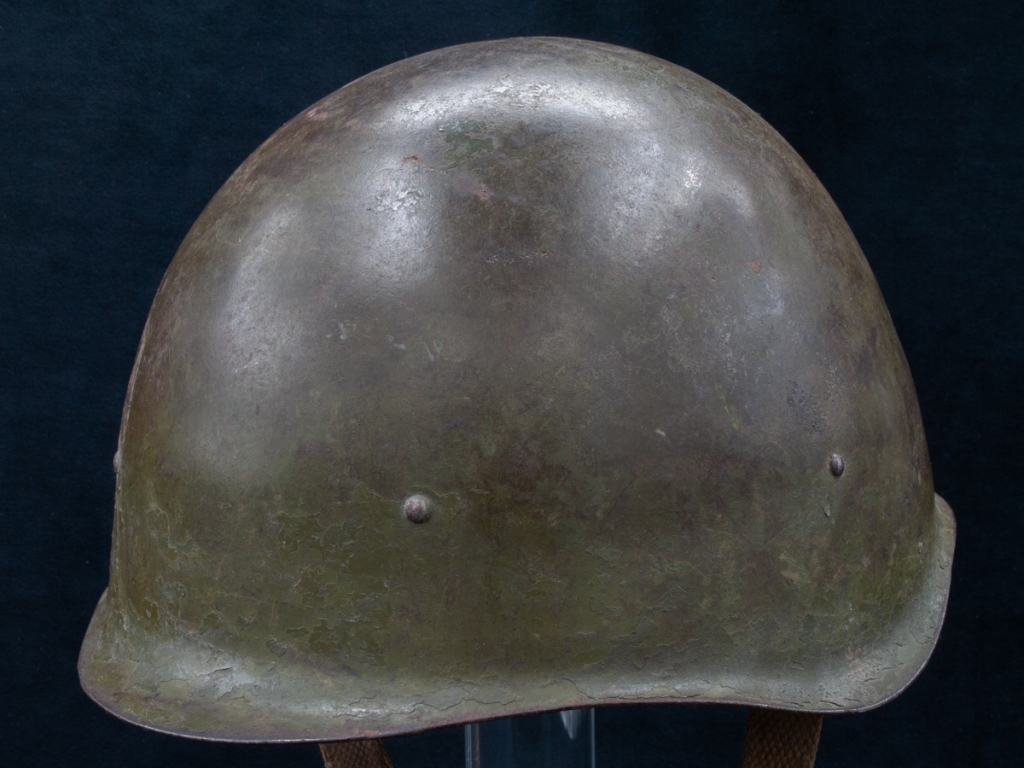
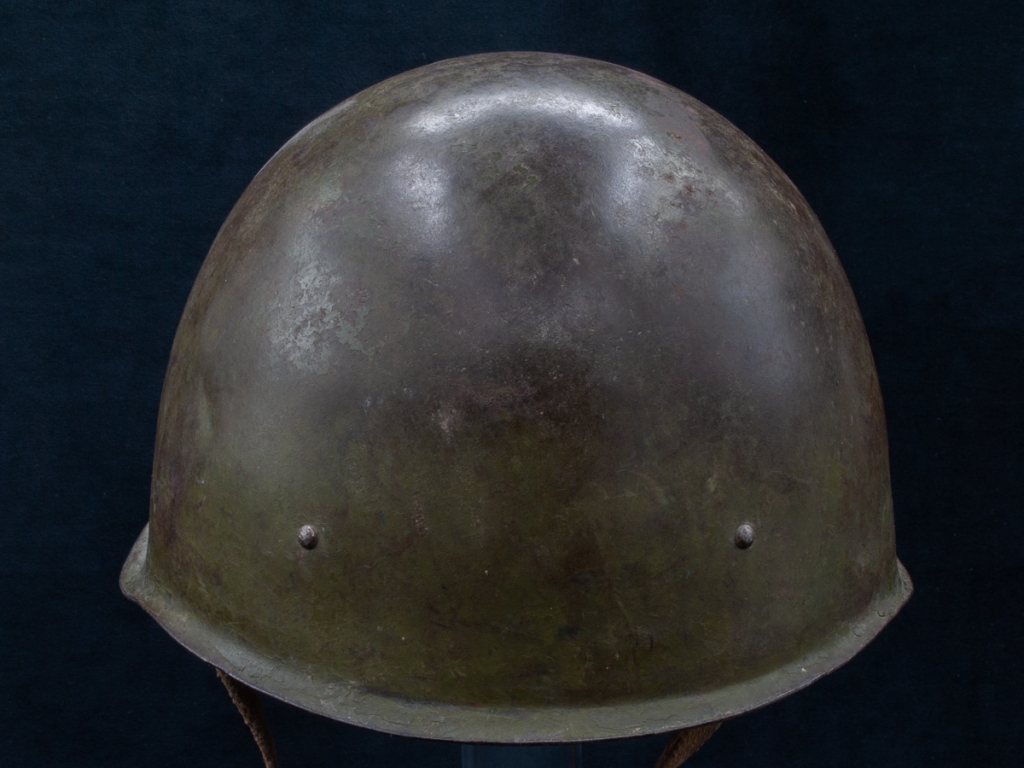
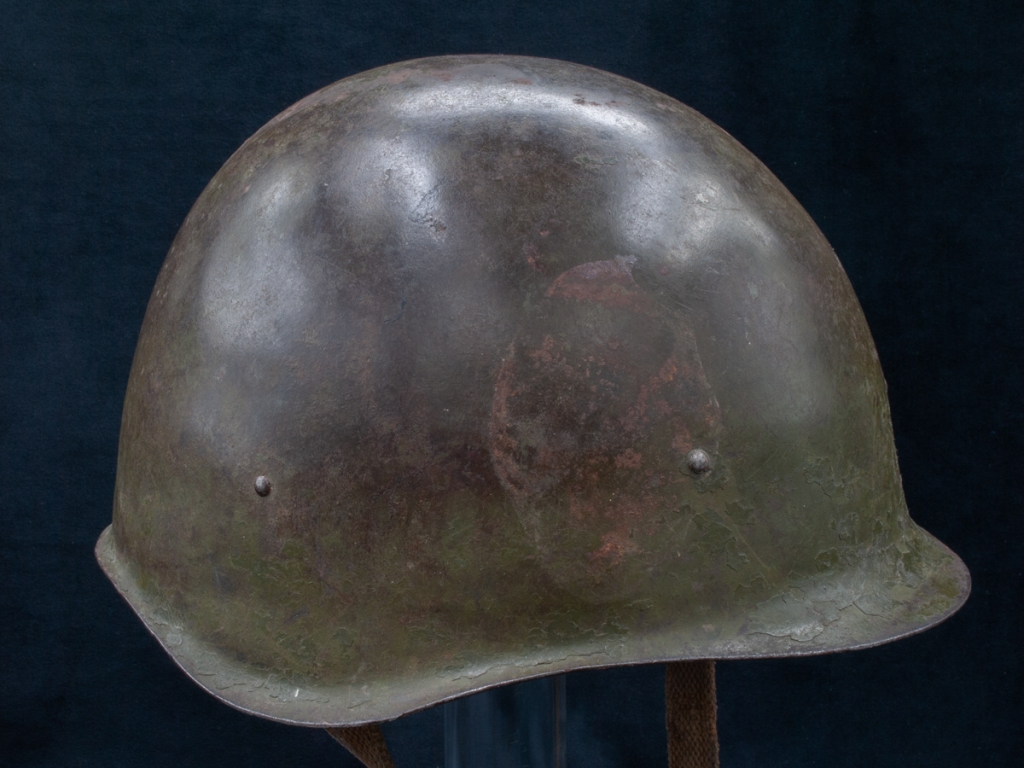
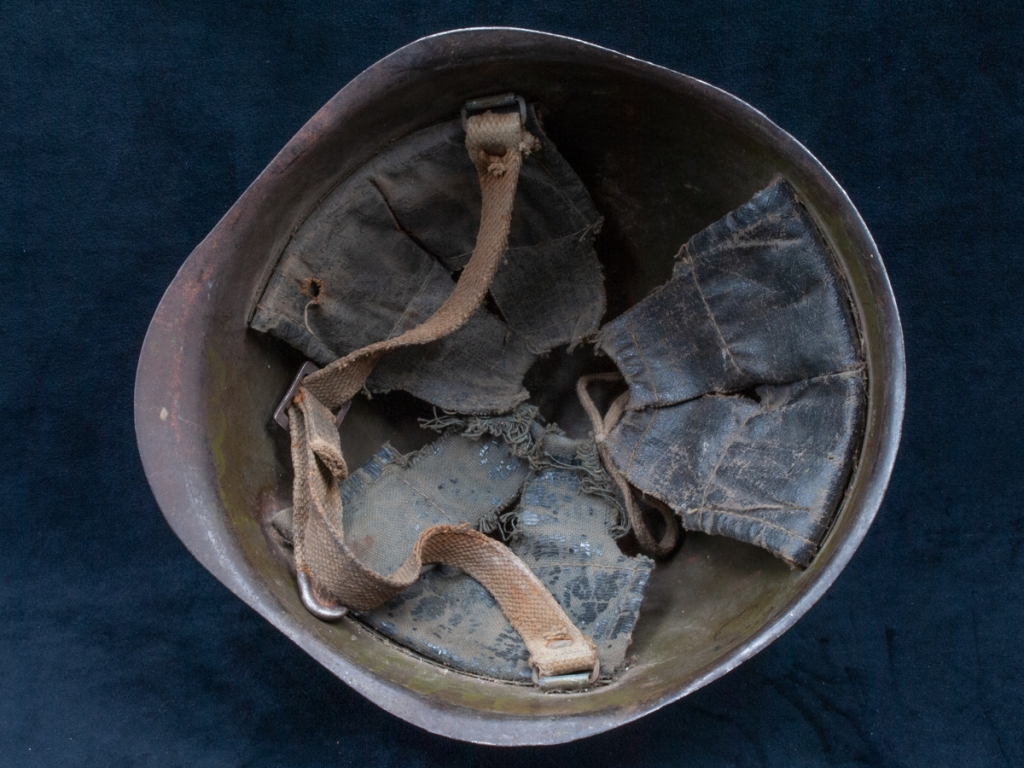
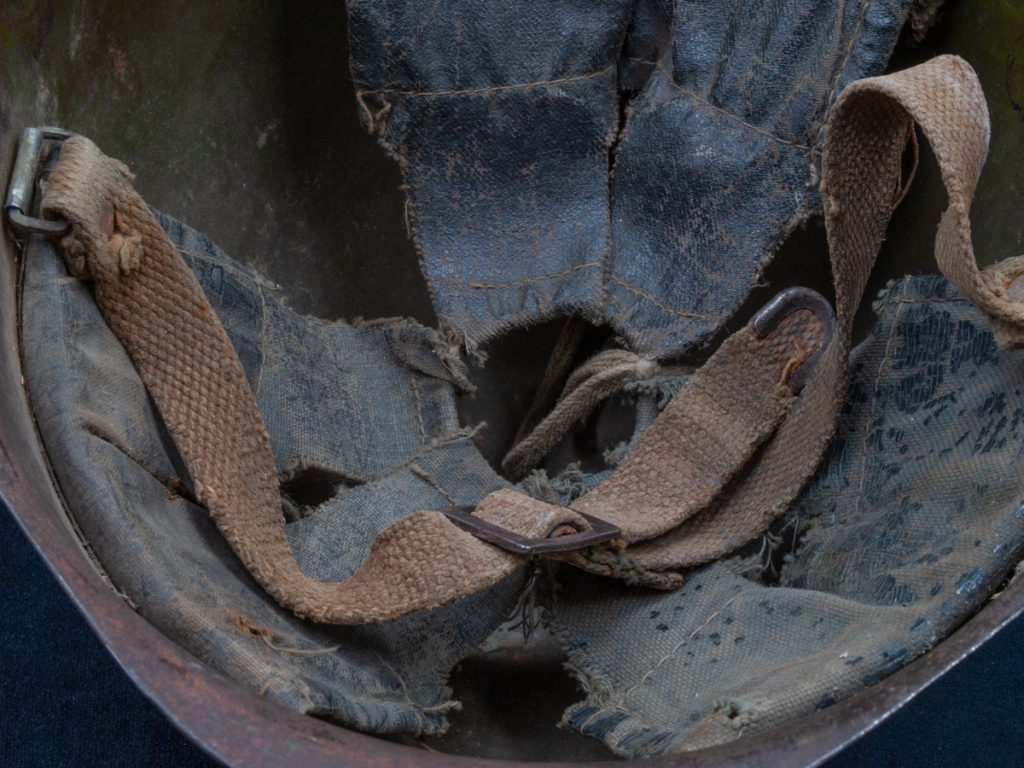
Displayed Example: I bought this helmet from a person who advertised it on a collector website. It is a wartime produced helmet that was refurbished at the Lysva factory in the late 1940s. It bears the typical Lysva postwar “spider” logo. To the left of the Lysva factory logo is a large “P” indicating that it was refurbished. The date is a little hard to decipher, but the first digit is “4” and the second may be “8”. The size in the ink stamp is not legible, but the cold stamp on the metal begins with the number “1” which is the size and corresponds to “small”. The helmet is missing the pillows behind the three liner pads. These were sometimes removed to accommodate larger head sizes. The liner material is from leftover wartime stocks and the liner is identical to World War Two liners. The chinstrap is narrower (19mm) than the typical postwar straps and may be constructed from recycled wartime material that was dyed.[14]
Collector Notes: Because the Lysva factory refurbished most of the SSh-40 after the war, finding one that has not been altered postwar is a challenge. There is a great deal of fakery with SSh-40 in collector markets. Typically this involves doctoring the ink stamp dates. Sometimes unscrupulous sellers will completely remove the original Lysva refurbishment ink stamps (the ones with the “spider” logo) and replace these with forgeries containing wartime dates.
A quick way to tell the good from the bad is to recognize postwar liners and chinstraps installed by the Lysva factory in the late 1940s. The most obvious visual identifier of a wartime model are the white cotton chinstraps that lack the horseshoe shaped metal reinforcing tip on the long section. For SSh-40s produced in the first three quarters of 1942, these may have chinstraps in the same style as those used on the SSh-39s. Wartime and postwar SSh-40s, therefore, are difficult to tell apart. Some collectors who have studied SSh-40s closely, however, can distinguish between SSh-40 1942 chinstraps with metal tips and those used postwar. The postwar chinstraps reportedly had a tighter weave and were usually slightly wider than the wartime ones (21mm vs 19mm).[15] Unaltered, early production SSh-40s are rare in the collector market, so as rule of thumb be skeptical of any 1942 dated SSh-40s with metal tipped chinstraps. SSh-40s with metal tipped chinstraps with wartime dates 1943-1945 are early postwar refurbished pieces that likely have counterfeit dates.
Another thing to check is whether the figures stamped into the metal match the ink stamps. For instance, the first numeral stamped into the metal before the batch number is the size. This should match the stamp size on the ink stamp. Similarly, a helmet with a five-point ballistics stamp in the metal on the visor should also have an ink stamp corresponding to the Lysva factory.
Resources: Analysis of SSh-40s can be difficult and this post contains only a summary of some key information. There is a greater amount of detail about these helmets that may be found in collector literature and in collector forums. What follows is a partial list of reference materials that I have found helpful:
- Karabanov, Ivan. The History of the Russian Helmet. Moscow, Russia. 2016. (Out of print, but sometimes available on secondary markets)
- Soviet Steel Helmets of the Second World War
- World War Helmets: A Reference for Helmets 1915 to Present Day
- WW2 Auction and Forum of Historical Items
- War Relics Forum
* Citation pending
[1] SSh is an acronym for “stalnoy shlem” which means “steel helmet” in Russian. In collector nomenclature it is equivalent to “model.” The helmet is also referred to as the “Model 1940” or “M40.”
[2] Karabanov. 2016. pp.318
[3] Karabanov. 2016. pp.320
[4] Karabanov. 2016. pp.319-320
[5] Madiot, Xavier & Claude Sorgius. World War Helmets: SSH 40 Helmet 1941/1945. https://www.world-war-helmets.com/fiche/Casque-Russe-Ssh-40-partie-1-1941-1945. Accessed December 17, 2025.
[6] Madiot, X ibid
[7] Madiot, X ibid
[8] Karabanov. 2016. pp.319
[9] Jack59 (aka). War Relics Forum. SSh-40 overhauled / “Remontnik”?. Post#2. June 2, 2025. https://www.warrelics.eu/forum/world-steel-helmets/ssh-40-overhauled-remontnik-843017/. Accessed December 17, 2025.
[10] Jack59 ibid
[11] Spłuszka, Sebastian. Personal communication. December 5-16, 2024.
[12] Spłuszka ibid
[13] Jack59 ibid
[14] Spłuszka ibid
[15] Sebastian ibid





 Steel Helmets of the World Wars
good afternoon. sorry, electronic translation. your helmet was released in 1945, but after the war it was repaired at the LMZ plant (Lysvensky Metallurgical Plant) in 1948. From the release of 1945, only iron remained in it, everything else was replaced with a new one. This was done with most of the helmets produced during the war years.
LikeLike
Is this my collector friend Ivan Karabanov? Interesting. Thanks. I remember reading something about this. What is the stamp that indicates that it was refurbished at the LMZ plant?
LikeLike
No, I’m Ivan Romanov. a mastic stamp speaks about the repair of 1947-1950 at the LMZ. there is a large letter P visible and an LMZ stamp in the form of a “spider”. it is well described in French WWH.
LikeLike
Thanks!
LikeLike