
updated 5/29/2025
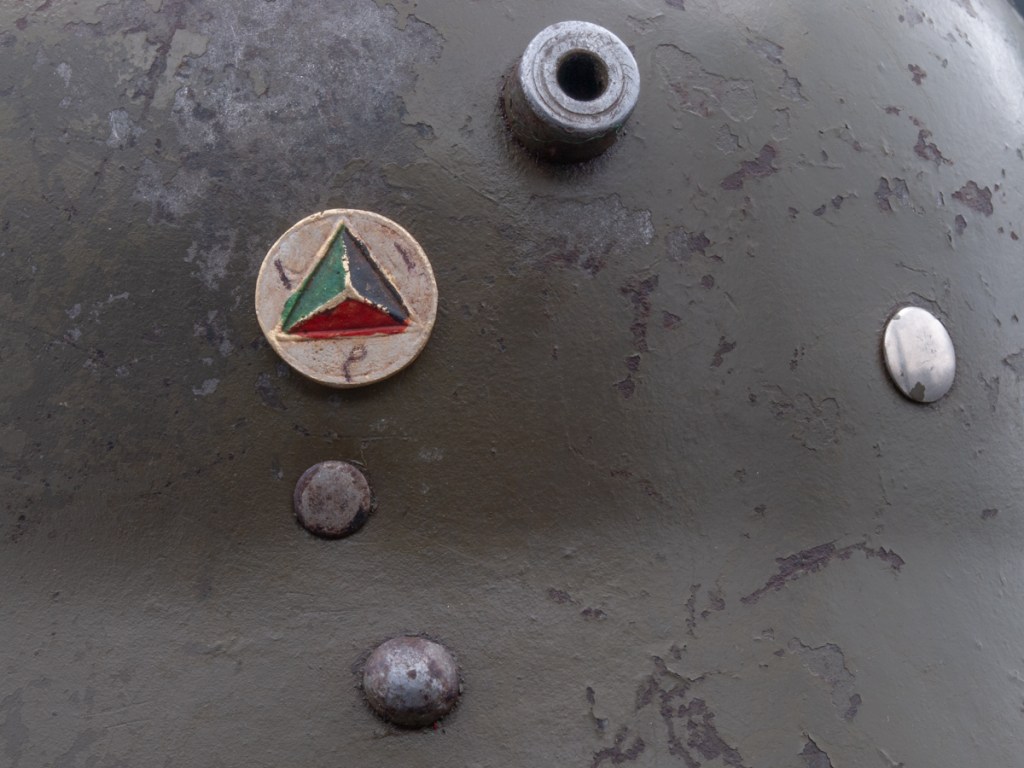
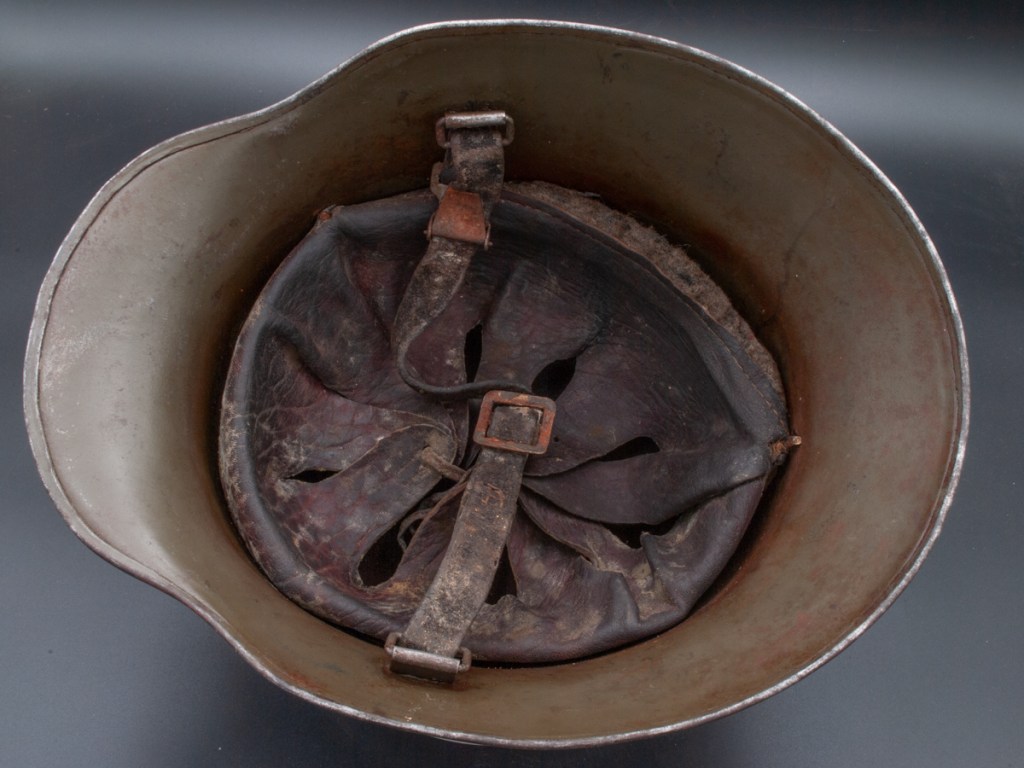
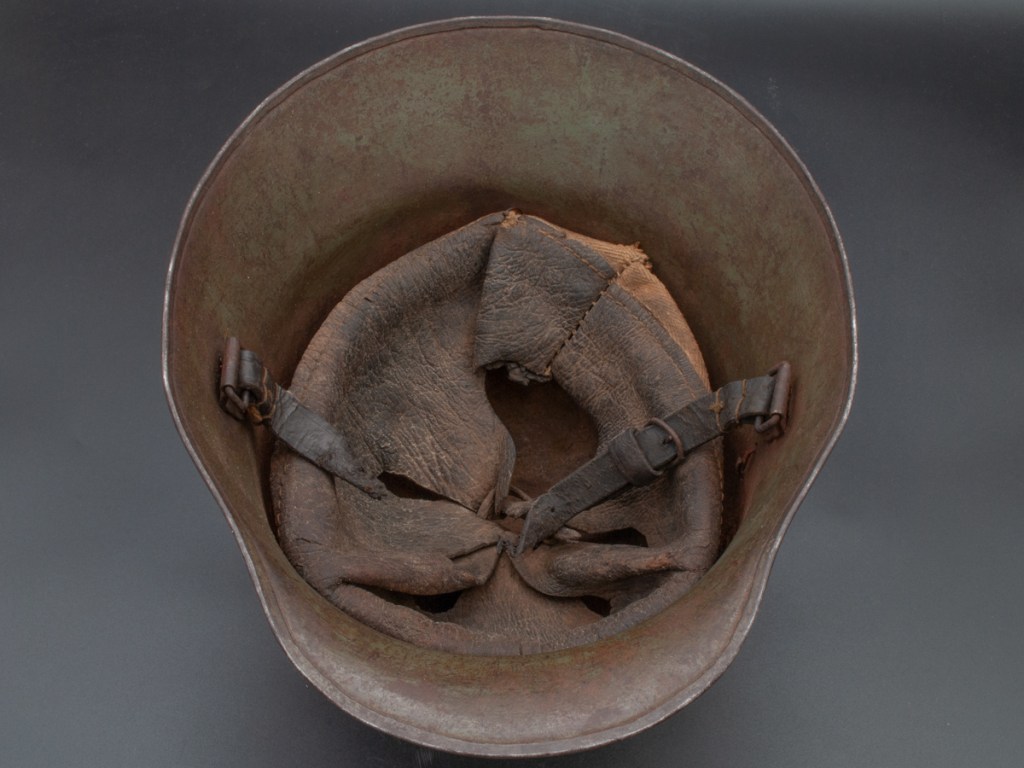
General Information: The Afghan army equipped soldiers with reissued German First World War helmets starting in the 1930s. They used a variety of German manufactured types including M16, M17, M18, and M18 ear cut out types. They also used Austro-Hungarian M17 and postwar Czechoslovakian vz20s.[1] These helmets were affixed with a badge consisting of a black-red-green “triple-triangle” within a circle were used by the Afghan Royal Army to 1973.[2] In 1973 there was a revolution that resulted in the overthrow of the country’s king. After this period, the badges of the Royal Afghan army were removed and the helmets were eventually placed in storage facilities. The liners and chinstraps were locally made. The leather used was from donkey hides according to the person who sold me one of the helmets displayed here.
The symbolism of the badge is as follows. Black represents the dark and troubled past of Afghanistan, including periods of occupation and hardship. Red symbolizes the blood shed for independence and the struggles during the fight for freedom. Green represents hope, prosperity, and Islam, the dominant religion in Afghanistan. The white background represents peace and purity. The three characters are letters in Arabic script that are abbreviations for God, the homeland and the king. This triad is similar to mottos used in other monarchies such as the British “God, King, and Country.”
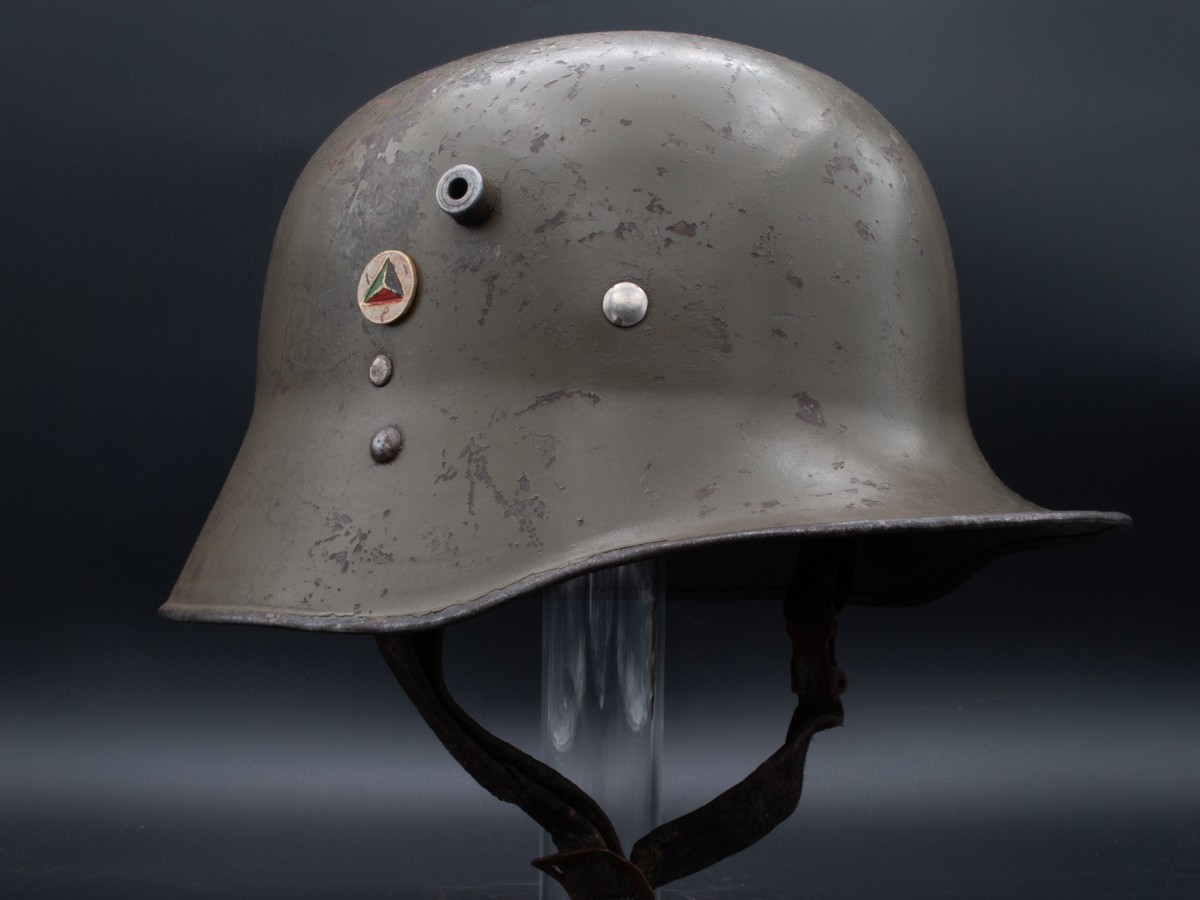
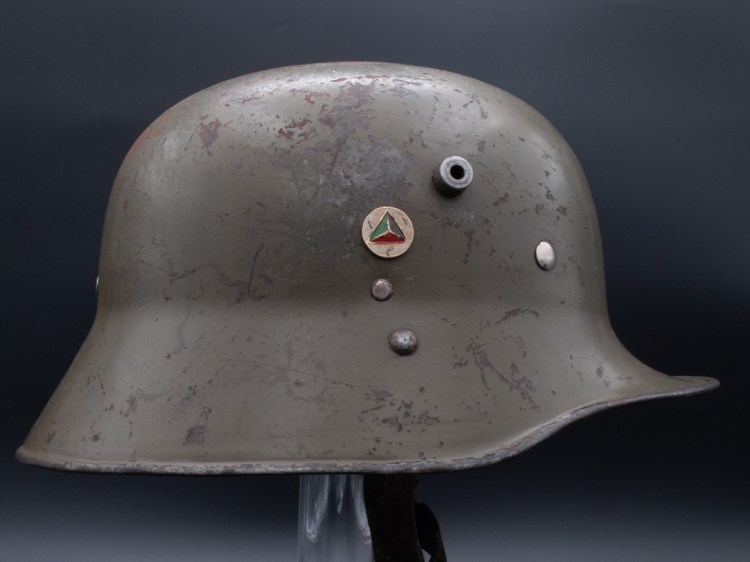
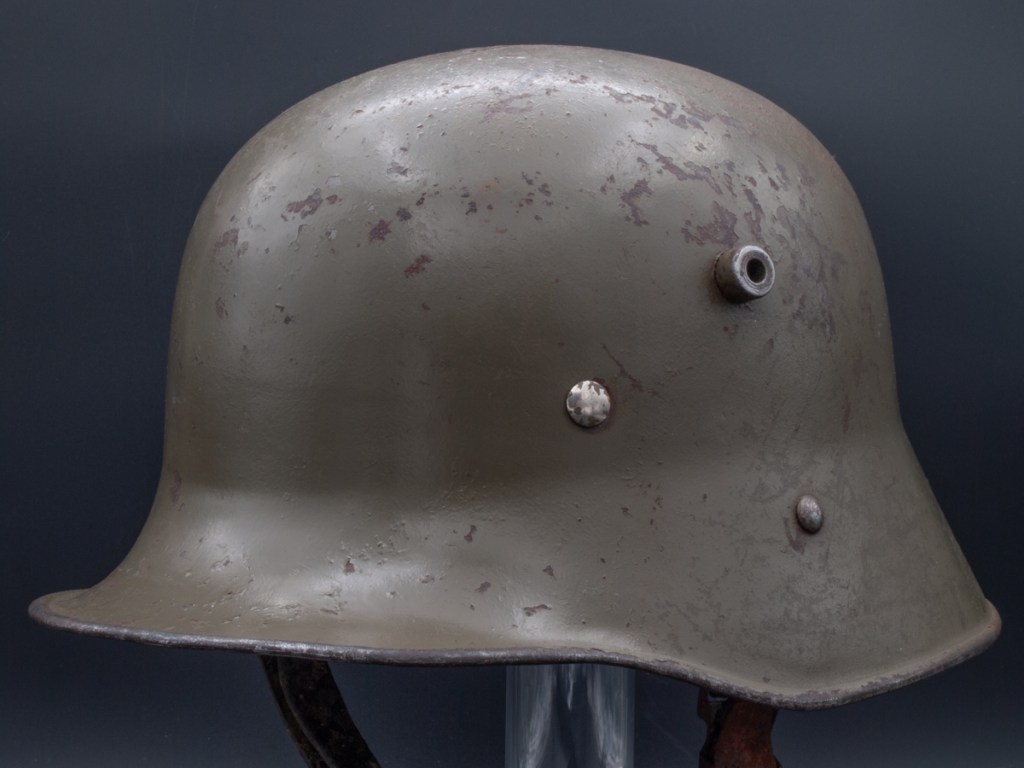
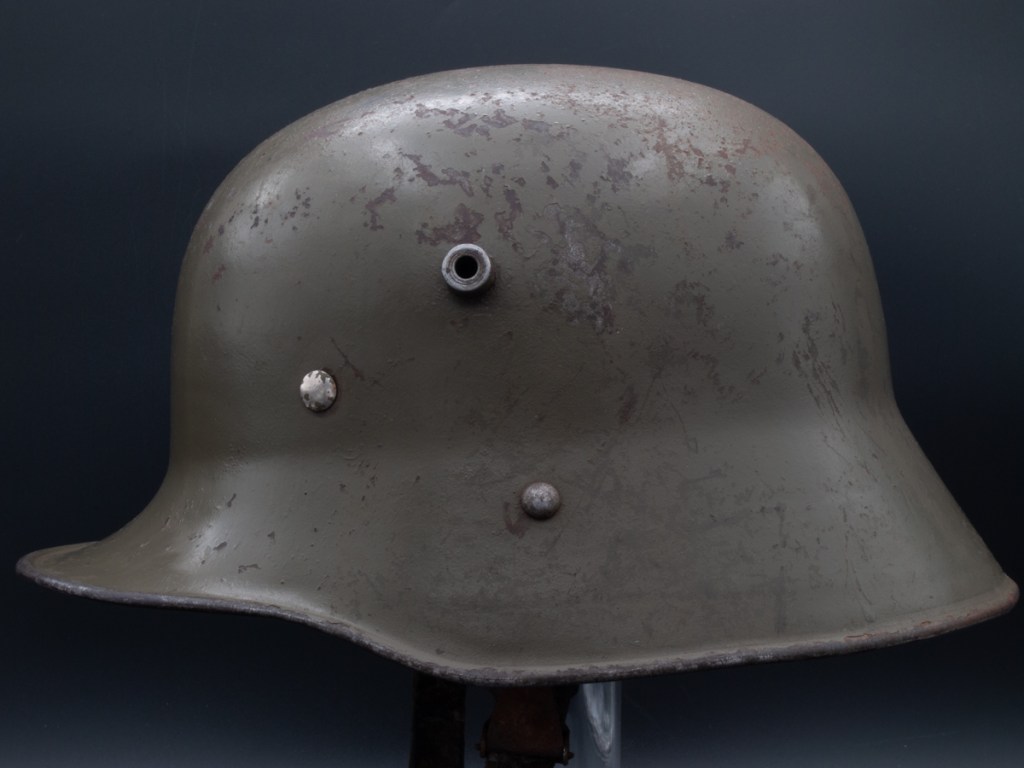
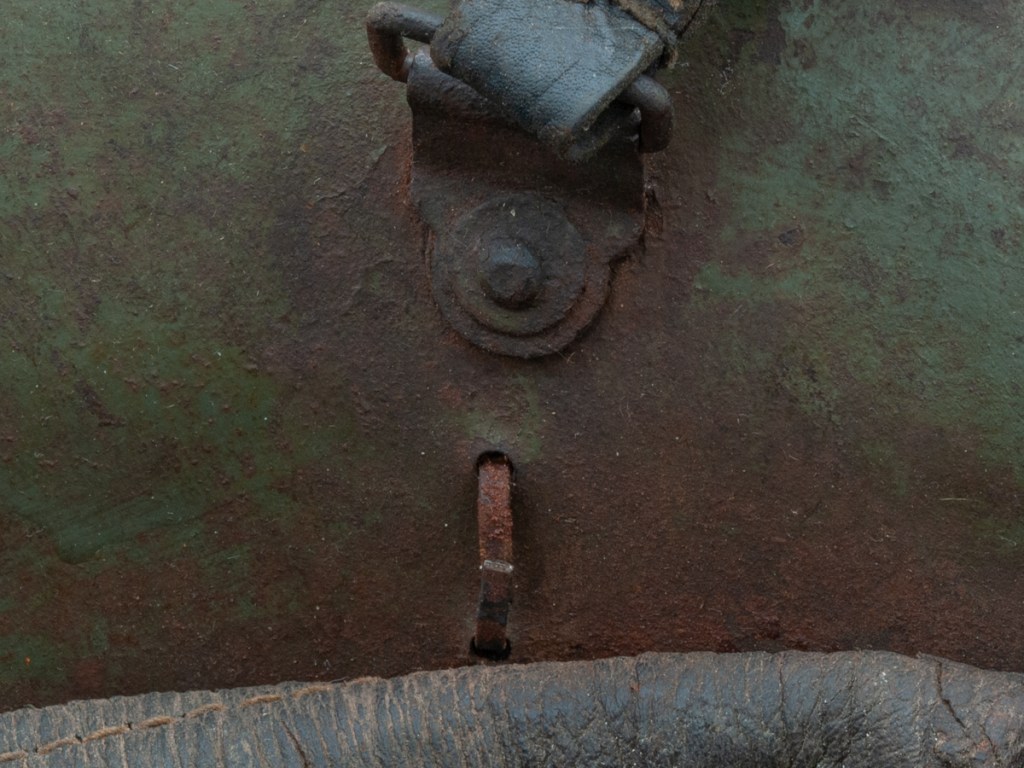
Displayed Examples: The first helmet in the photograph gallery below was brought back from Afghanistan in 2005 by a British officer serving at Camp Eggers in Kabul with the Combined Forces Command – Afghanistan (CFC-A) as part of Operation Enduring Freedom.[3] It is a post-World War One Czechoslovakian produced helmet. The Czechoslovakian helmets all lacked stepped side lugs that were a feature of the small to medium sized German and Austro-Hungarian helmets. They also lacked manufacturer stamps like those found on their wartime counterparts. The chinstrap on this helmet is nearly the same type used on the early-production Bulgarian M36-As which were manufactured in Czechoslovakia and also early-production Czechoslovakian vz30s exported to Spain. The same clip type chinstrap attachment and relatively large sliding buckle were used on First World War helmets made by the Berndorfer factory (see Austro-Hungarian Berndorfer) and the early post-WWI Czechoslovakian vz20s.
This specimen is the best helmet of this type that I have been able to lay hands on. It is exceptional to find an Afghan German-style helmet with its original liner, chinstrap, and badge. The helmet has two holes to accommodate a large Royal Afghan Army badge, but instead of a large badge it has a smaller version of this fixture and the extraneous lower badge hole is plugged with a small split pin rivet.
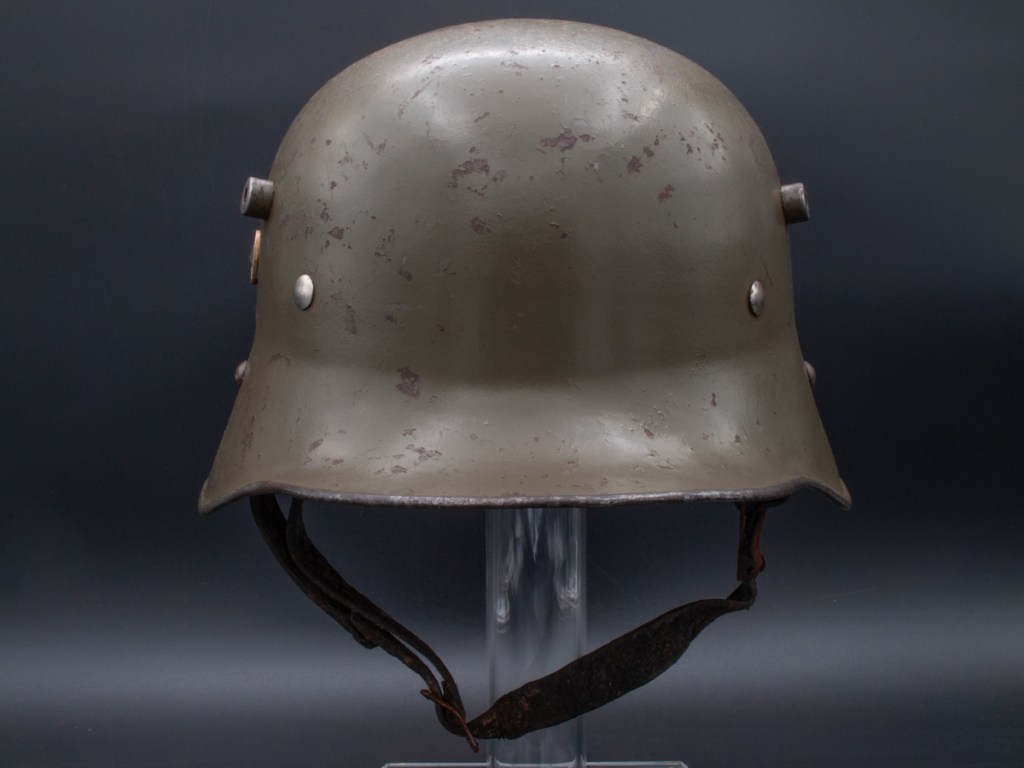
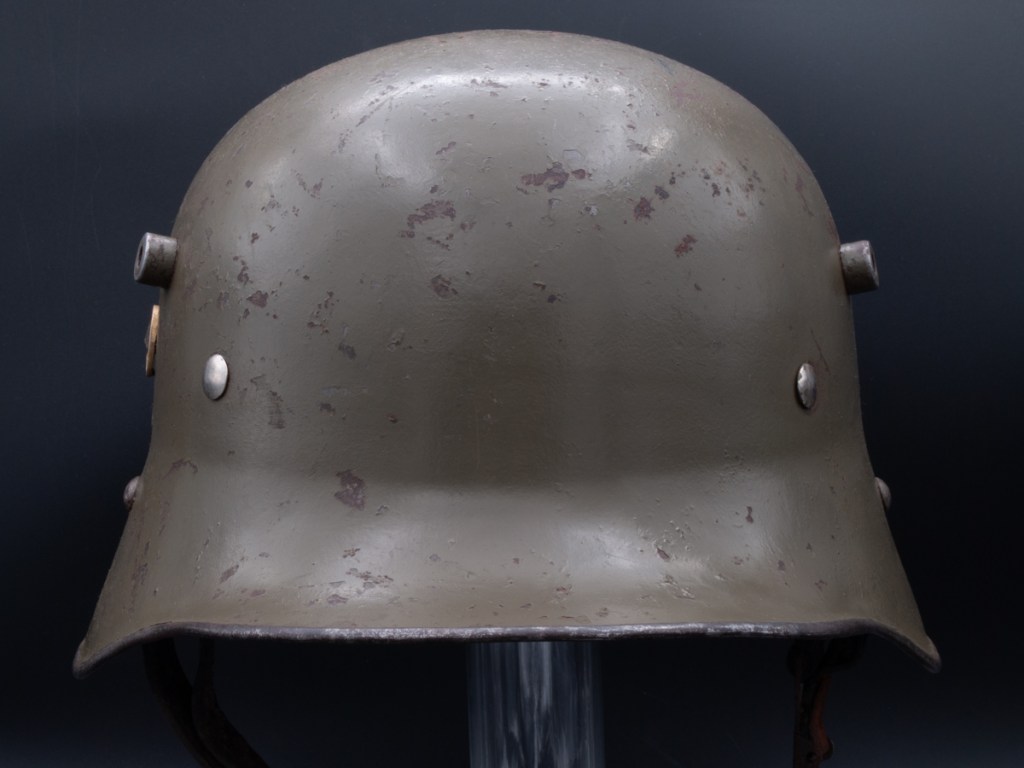
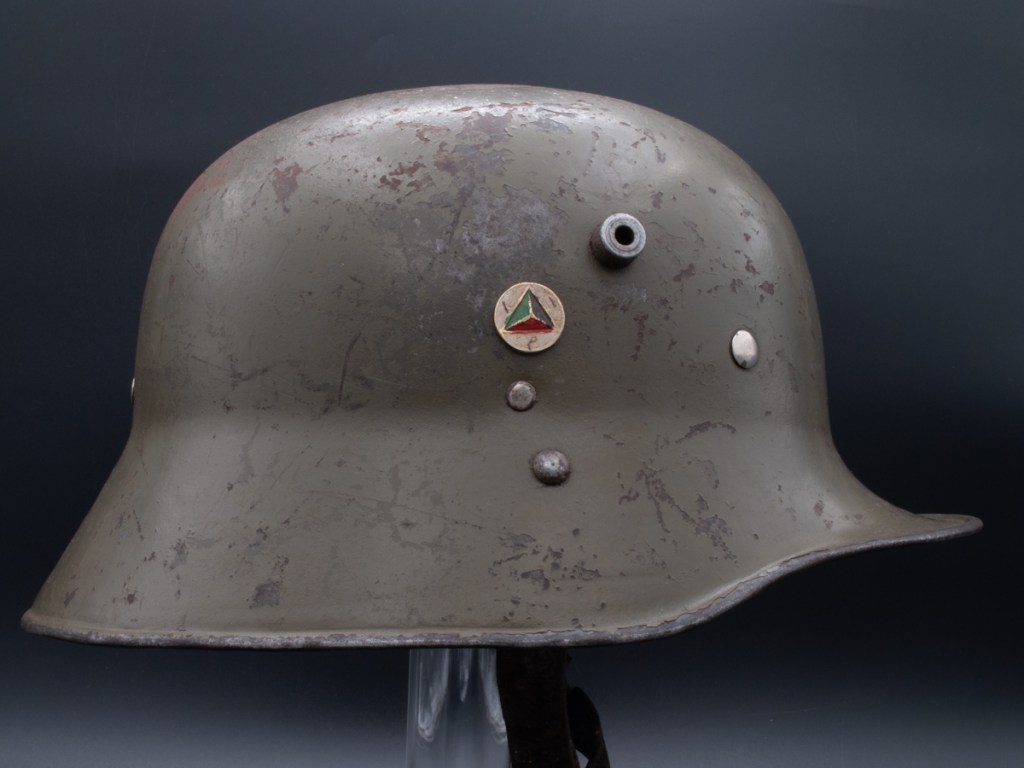
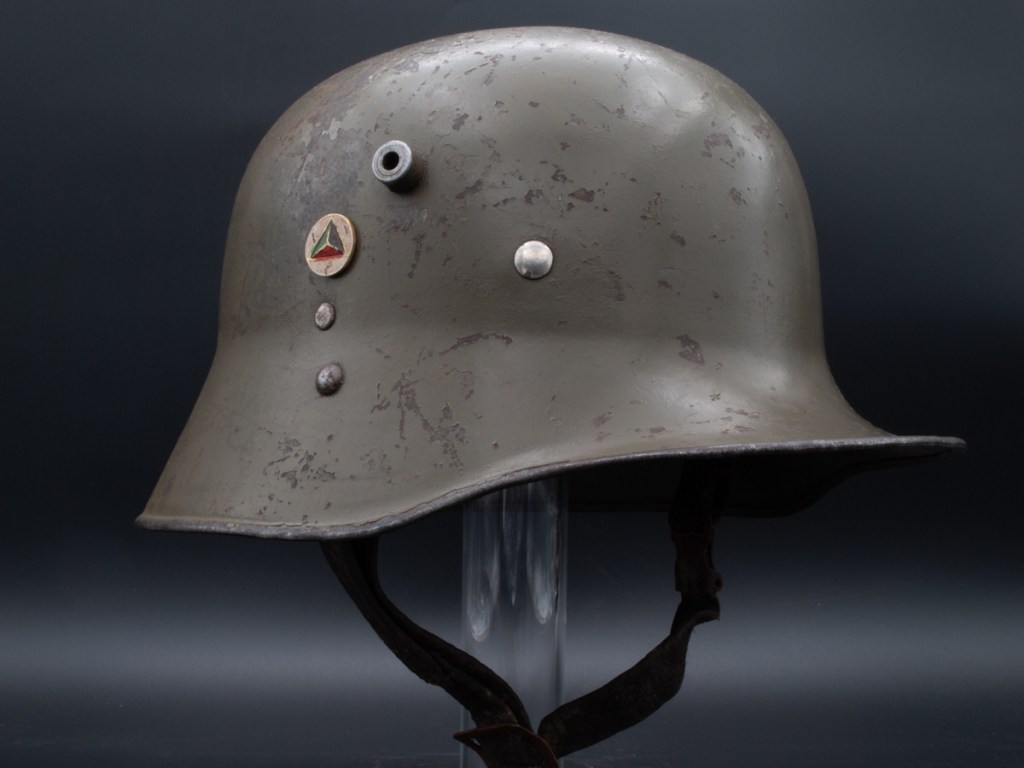
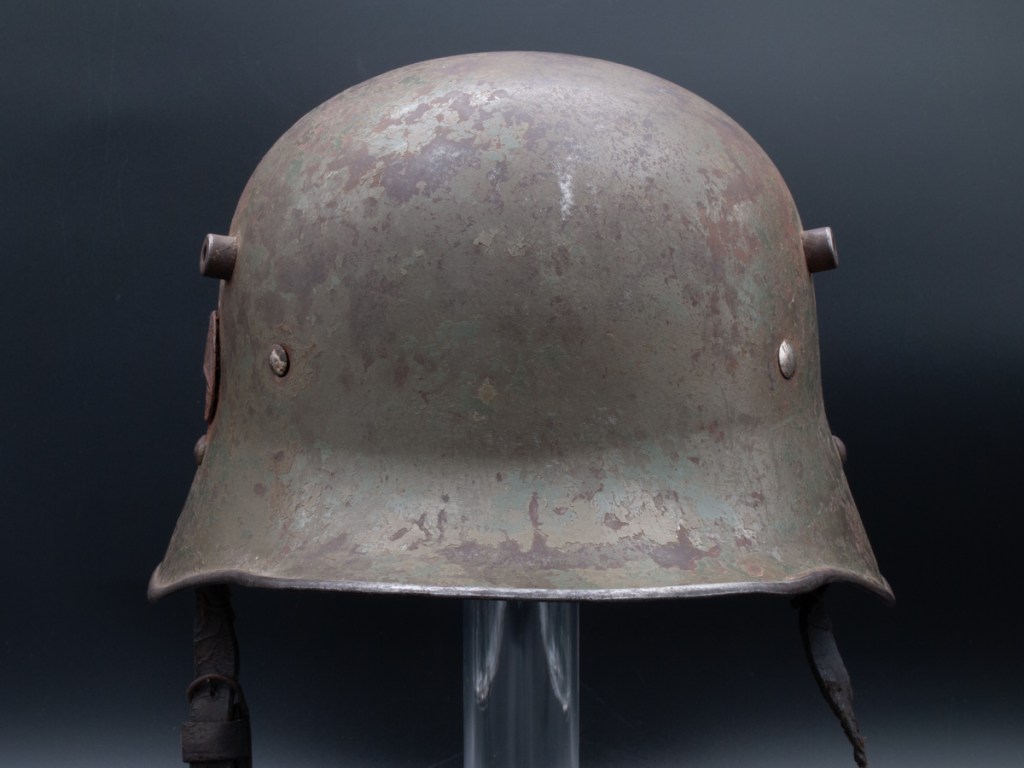
The helmet in the second set of gallery photographs below also came from somebody who had served in Afghanistan. There was a bazar in Bagram where Afghan dealers brought a wide variety of things to sell. The seller told me that he saw hundreds of this kind of helmet for sale in this market, but this was the first one he saw with a liner. That is what attracted him to this piece.
It is hard to say definitively, but the second helmet also appears to be a Czechoslovakian postwar manufactured helmet.
The helmet has its made-in-Afghanistan liner and most of its chinstrap although the chinstrap is broken in the middle. The original and hard-to-find Royal Afghan Army badge is present on this example, but it is oxidized and has lost its original paint which would have consisted of black-red-green triangles on a white background.
Collector Notes: Afghan reissued German WWI helmets are generally found without badges and more often than not without liners and chinstraps or with partial internal components. They are almost always in rough shape. These historically interesting helmets can be purchased for prices at the lower end of the price range. Finding one with complete liner and chinstrap and/or badge is a real challenge and you can expect to pay more for one in complete condition, although the price will still be significantly lower than it would be for an equivalent German First World War helmet that was not exported to Afghanistan even though these are much more common. Reproduction replacement badges are available and are sometimes artificially aged by collectors. That is one thing to look out for.
* Unknown, “Khrushchev and Bulganin in Kabul.” December 1955. Shattering Afghanistan: State Destruction and Mass Murder in Central Asia. Accessed January 30, 2024, https://shatteringafghanistan.omeka.net/items/show/14
[1] Marzetti. pp 10
[2] “WWII gear in Afghan use: Part II –uniforms.” Wwiiafterwwii. June 1, 2015. https://wwiiafterwwii.wordpress.com/2015/06/01/wwii-gear-in-afghan-use-part-ii-uniforms/. Accessed November 19. 2024.
[3] Anzacblade (aka). Personal communication. October 13, 2024.










 Steel Helmets of the World Wars