
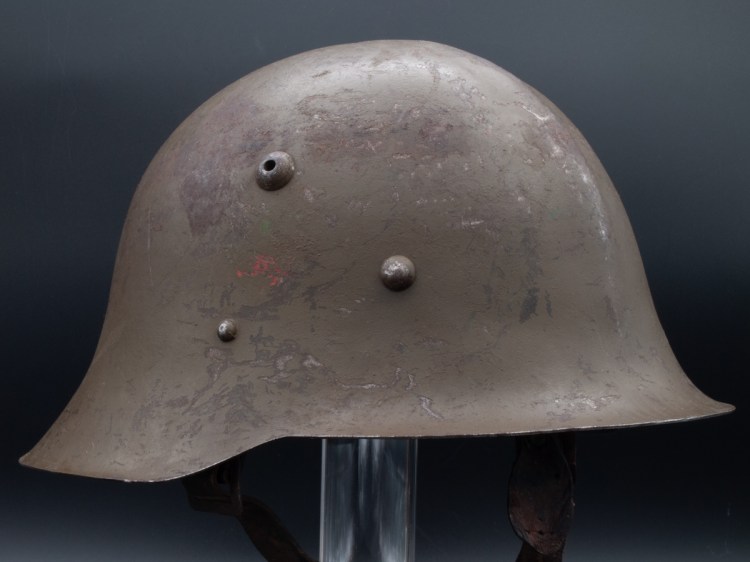

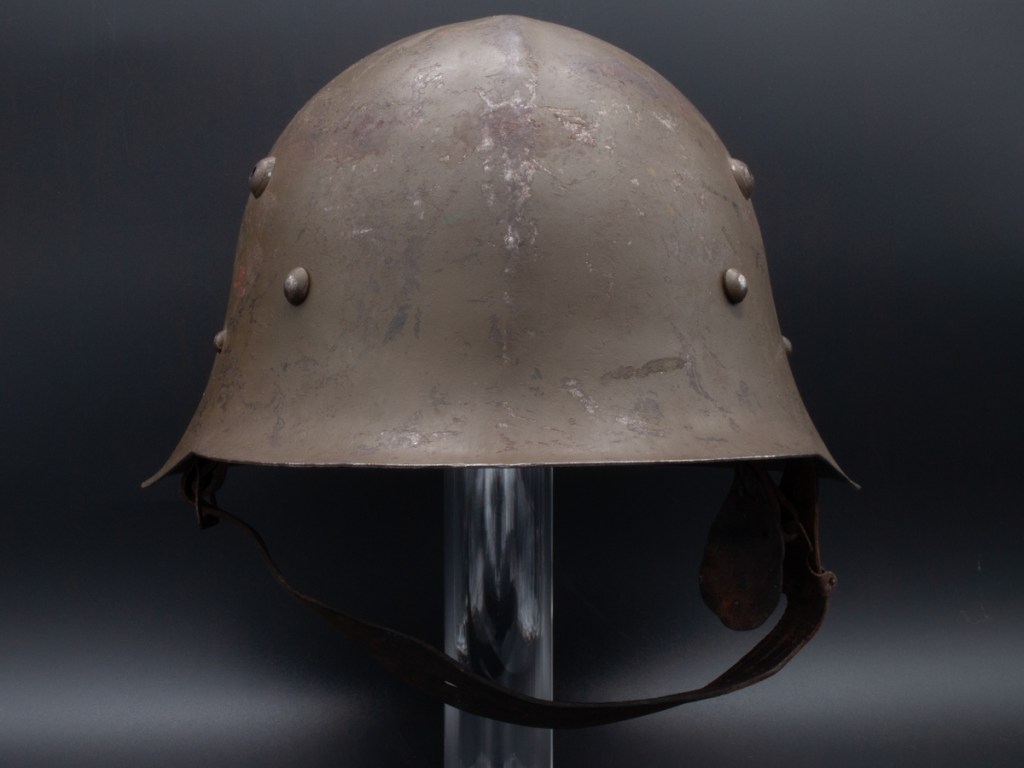
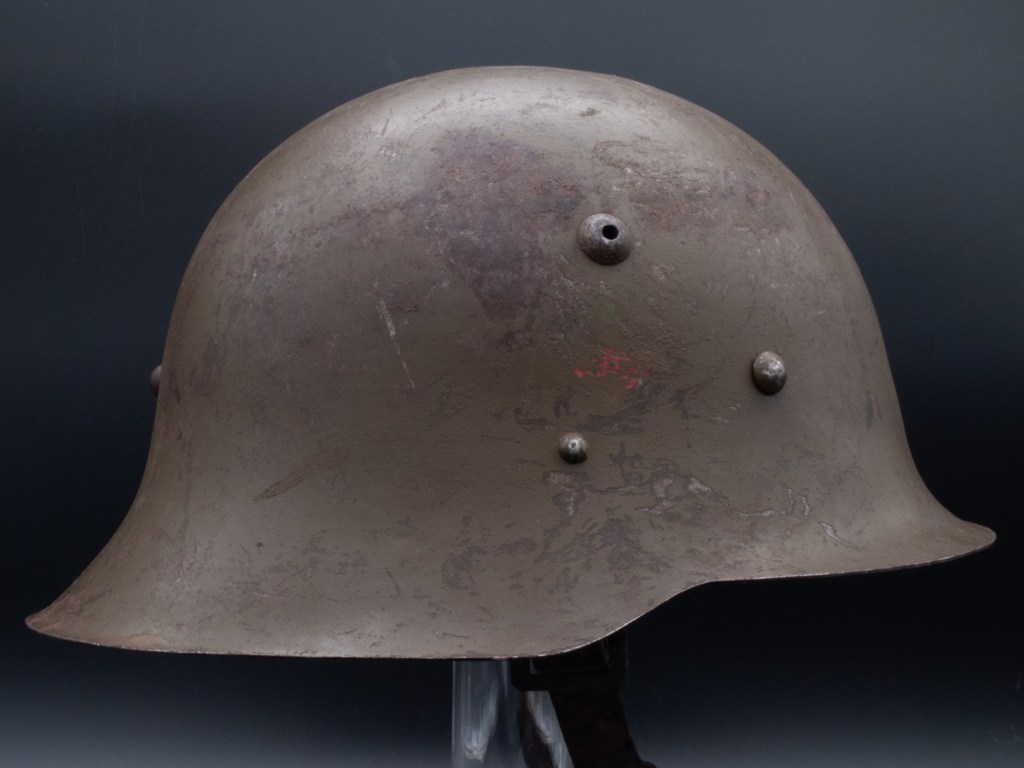
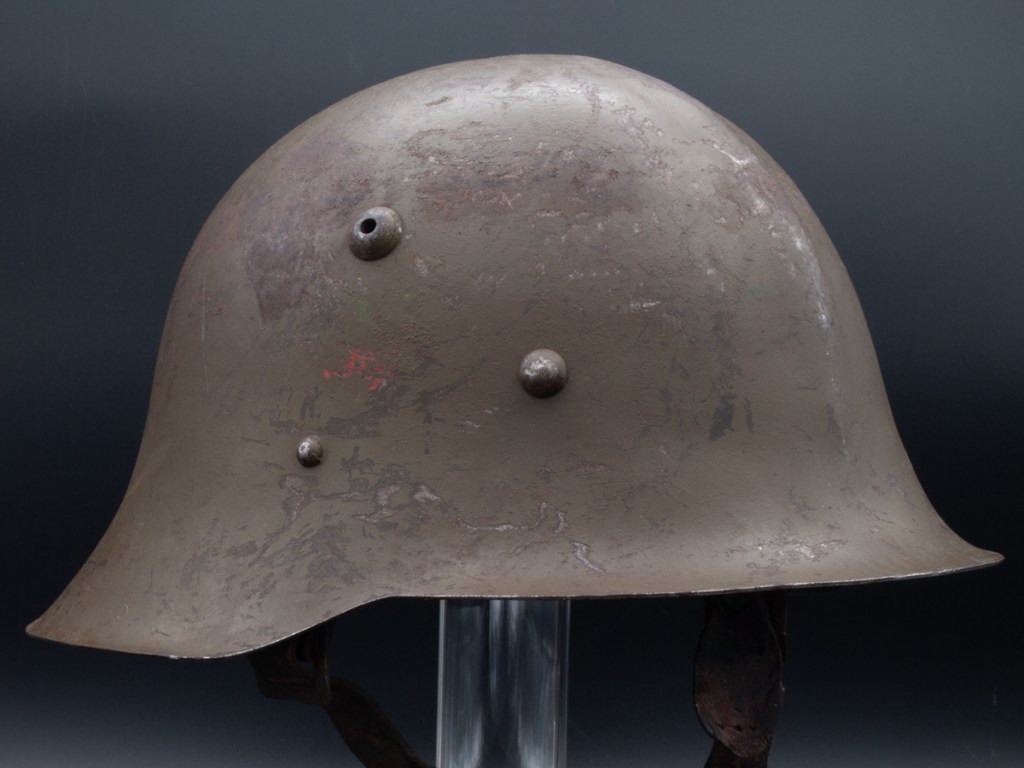
General Information: “Model 1936B” is a collector term to describe one of three Bulgarian helmet types used in the Second World War. Whether this helmet had an official designation is currently unknown. The M36B is the least common of the three. Approximately three or four percent of the M36s were this type.[1] It is basically the same as the M36A (see Bulgarian M36A), but it has a raw edge rather than a rolled edge. Early production versions had the same liners and chinstraps as the M36As, but the Bulgarians seemed to have been experimenting with liner styles as surviving wartime configured examples of M36Bs have a variety of liner and chinstrap types. These helmet liners were attached with either three or four domed rivets. The four rivet types apparently had a short production run and are quite rare.
The M36Bs may be considered a transition between the A and C versions of the M36 as the Bulgarians experimented with streamlining production and reducing costs similar to the transition that the Germans made from the rolled edge M40s and the raw edged M42s.[2]
It is unclear where the M36Bs were manufactured, but it seems likely that they were made in Bulgaria[3], although Czechoslovakian manufacture seems plausible as well.[4]
Displayed Example: Almost all the M36 helmets on the collectors’ market have been sourced from Bulgarian military storage facilities. This helmet had a different journey. I bought it from a Ukrainian dealer. He, in turn, bought it from a friend who found it in a town in the Cherkasy region, which is in central Ukraine. Originally the helmet was displayed in a small museum housed in the village school. Students at the school brought in things related to the Second World War. The town fell into decline and the school was abandoned. Villagers looted the museum. Subsequently, the seller’s friend was able to purchase some of the looted museum items from the villagers, including the helmet displayed here. The Bulgarians served as occupation troops in parts of the Ukraine and it is likely that the helmet belonged to one of these soldiers.
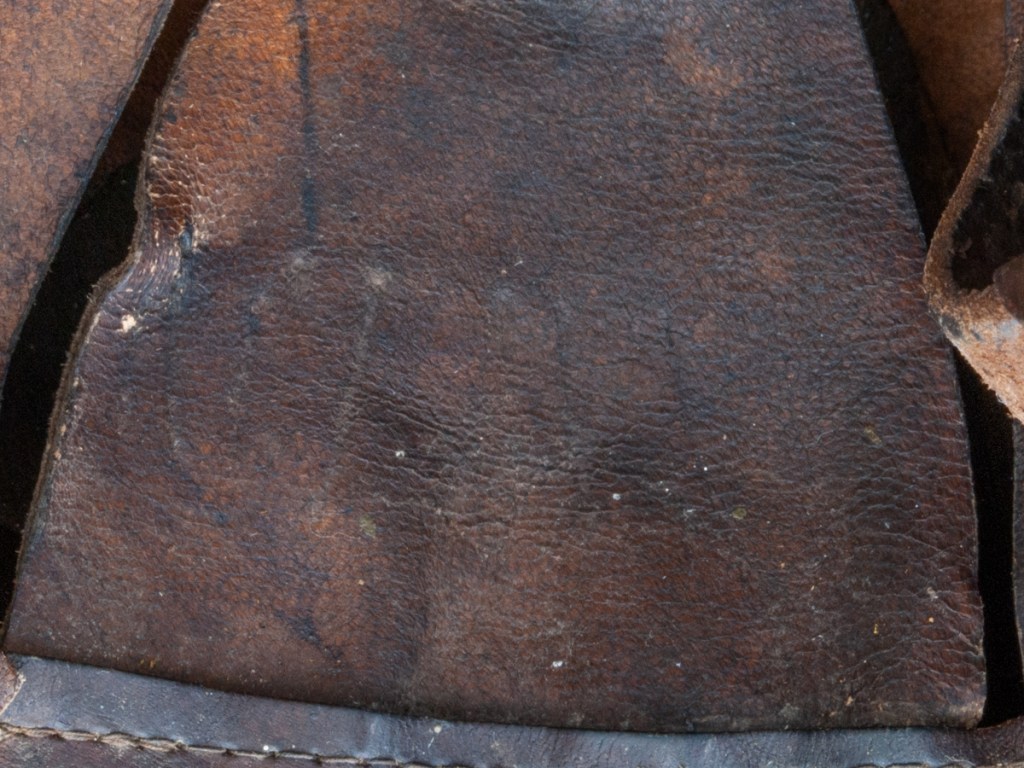
The helmet is a rare example of a M36B in its original World War Two condition. It has the type of liner originally used in the M36As. The liner consists of seven triangular leather sections with pointed ends and steel reinforced eyelets for the rawhide drawstring. These are stitched to a leather strip which is attached to a metal band. The band has five holes to accommodate split pins. Since the liner is attached with just three rivets, two holes are extraneous. It seems that the band was originally designed to attach to a helmet like the M36A or four-rivet M36B, and the rear hole may have been a modification to make it work with a three-rivet M36B. This suggests that the original configuration of the M36Bs was with four rivets and this was changed later changed to three rivets perhaps as an economic measure. The liner bands that had been produced up to that point would have been modified by drilling a hole in the back for the three-rivet version. There is a leather pad attached to the interior dome. It is stamped size 57 and the original owner’s name or initials are still partly visible on one of the triangular sections.
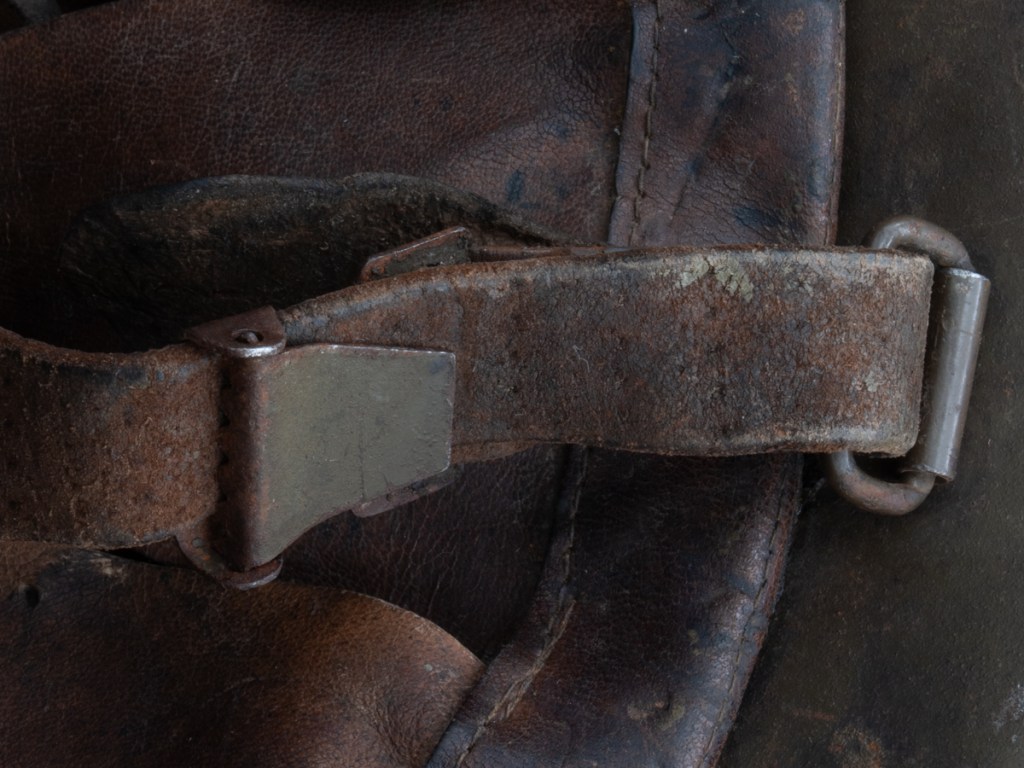
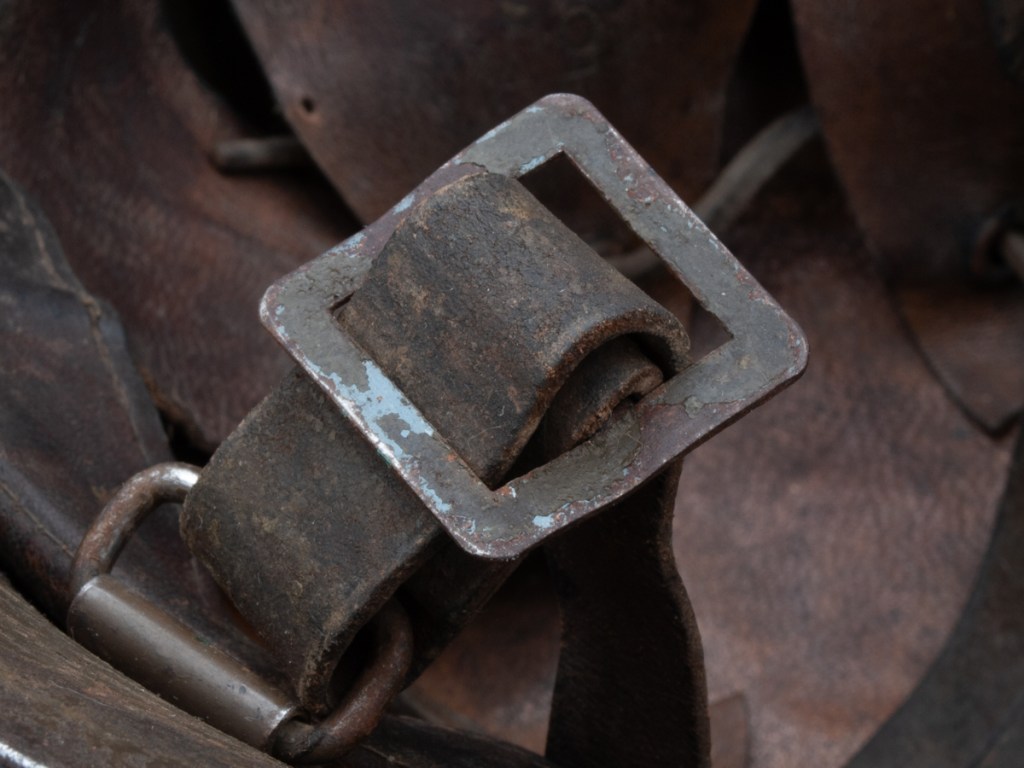
The chinstrap is almost the same as ones used on some Czechoslovakian helmets exported to Spain and Afghanistan (see Afghan). The difference being the split middle section of the chinstrap which was used on later production versions of the German model vz.20 and the Czechoslovakian vz.32. The chinstrap hardware with clip type attachment and sliding buckle were originally developed for the Austro-Hungarian Berndorfer helmets (see Austro-Hungarian Berndorfer). As with all M36s, there are no markings on the helmet shell.
The helmet was repainted using a dark green color of paint found on some wartime helmets, but not on postwar refurbished helmets. The original tricolor decal is faintly visible under the paint on the right side.
Collector Notes: The Bulgarian M36B is the scarcest of the three types of Bulgarian helmets. Finding one in its original WWII state is a great challenge. That said, the collectors’ market does not make significant distinctions in value between wartime and postwar configured pieces. This is partly due to the lack of knowledge about these helmets among collectors. If you are lucky enough find one of these rare pieces, therefore, you may be able to purchase it for a modest price.
* Citation pending
[1] Jacobs, Walter. Personal communication. This rough estimate is based on observation of hundreds of surviving examples of the M36.
[2] Speculation on my part.
[3] Jacobs, Walter. Personal communication. March 2025.
[4] The question of the location of M36 manufacturing is addressed in the post on the Bulgarian M36A.





 Steel Helmets of the World Wars