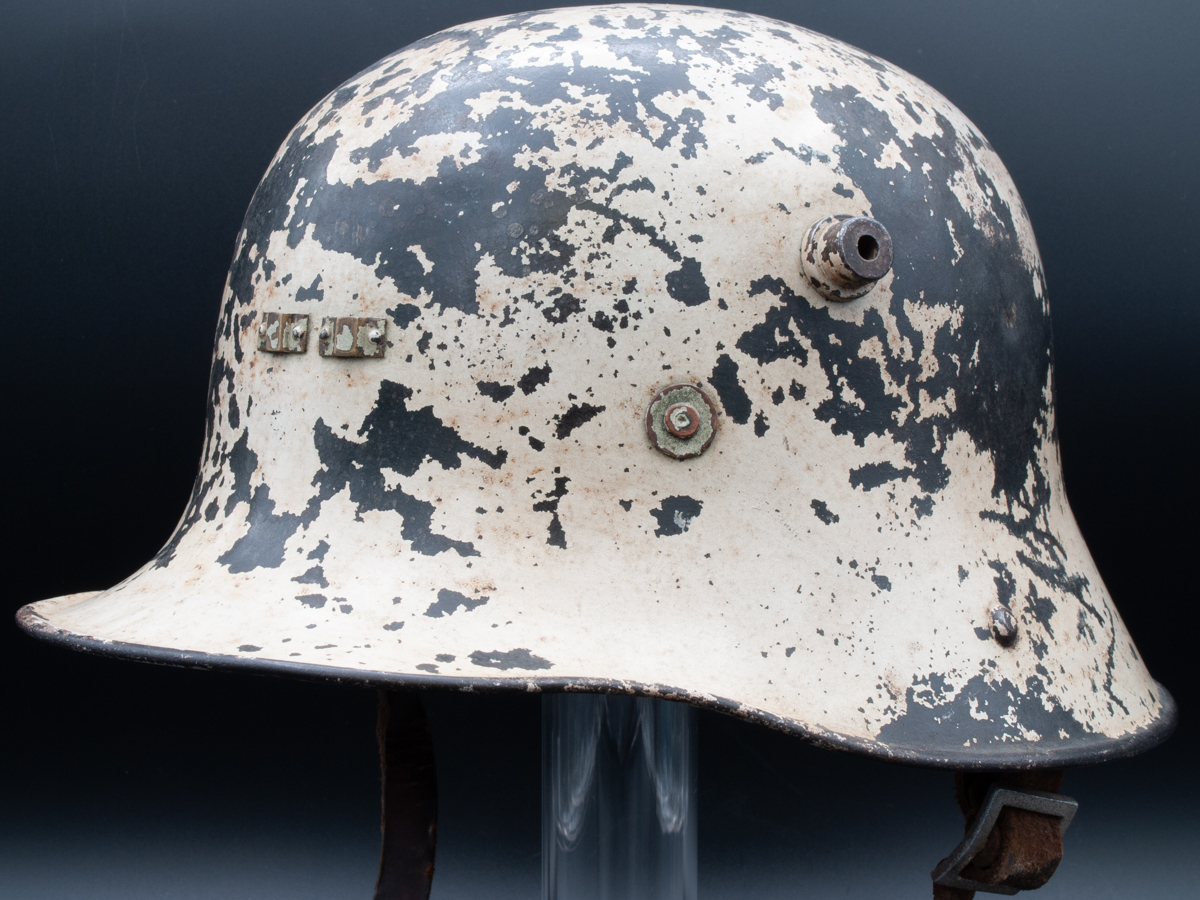
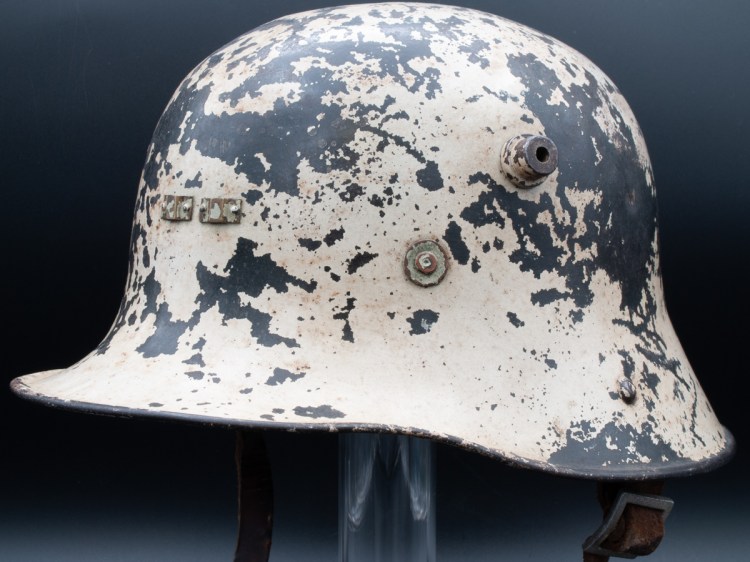

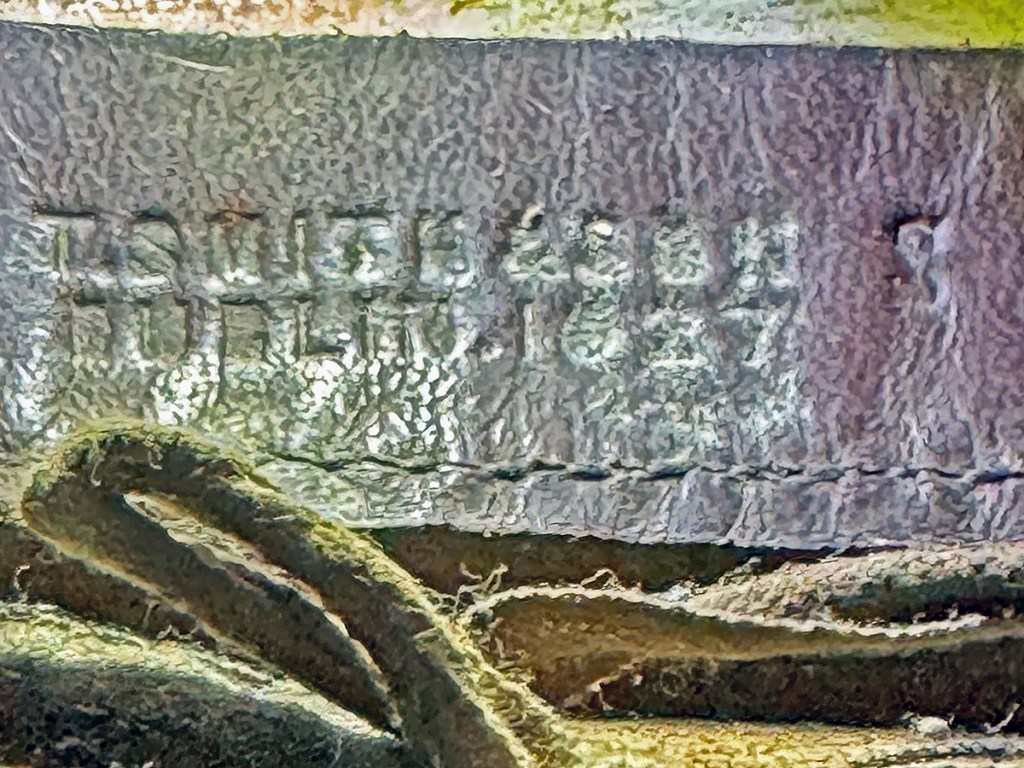
General Information: The army of the Irish Free State used the Model 1927 helmet from 1927 to 1939. After this period, the helmets were painted white and issued to the Civil Defense forces. The helmets were copies of the German Model 1916. The famous British firm, Vickers, manufactured 10,021 of the M27s. Vickers used low quality steel that provided little ballistic protection. Because of the weak material, surviving examples often have dents. Each helmet is individually numbered by a stamp on the rear visor. The “H” preceding the number signifies “helmet.” In the same location there is a “V. Ltd.” for Vickers Limited. The M27s came in two sizes: Large and Small. The shell size is indicated at the top of the stampings on the rear visor with a “+” indicating large and a “-“ indicating small. Collectors often refer to the M27 as the Irish “Vickers” helmet.
The T. Smith & Son firm of Dublin produced the helmet liners which bear the stamp of the manufacturer on the liner band. The size is indicated by an “L” or “S: stamped on the liner band.[1] Both the liners and chinstraps are copied from the German Model 1916 pattern. Unlike the German M16 chinstraps, however, the M27 chinstraps typically have one slide buckle, although some have two.
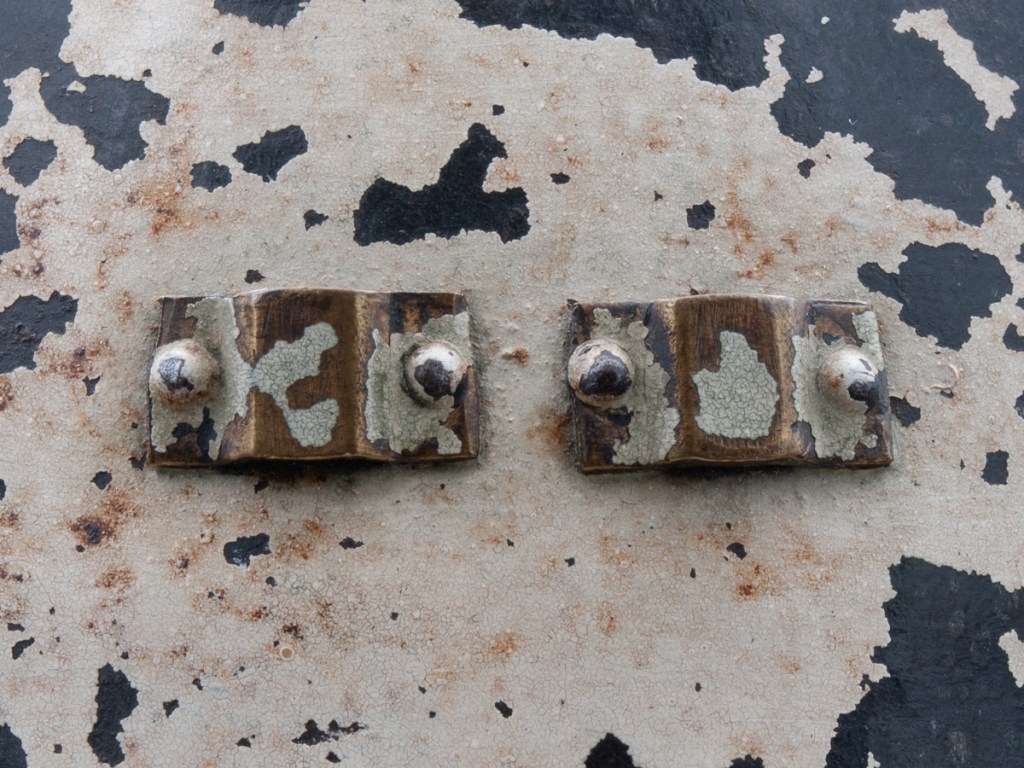
The Irish M27s can be quickly distinguished from their German cousins by the pair of brass brackets welded to the front. The purpose of the brackets was to affix a double pronged brass badge which was like the badge used on the caps of officers of the Irish Free State. The badge used on the Vickers helmets was adorned with the initials “FF” and the motto in old Irish Celtic Gaeilge, “ÓGLAIG NA h-ÉIREANN.” The “FF” stood for “Fianna Fáil” or “Soldiers of Destiny” in English. The motto translates as “Warriors of Ireland.”[2]
The choice of the German style helmet may seem odd, but the Germans had provided the Irish with clandestine military aid during the First World War and there was pro-German sentiment in Ireland. In addition, the Model 1916 stahlhelm had proven to be the best helmet of the Great War conflict. Presumably, these were factors that contributed to the choice of the M27 design. It is ironic that the steel shells had to be procured from a company in the erstwhile enemy of the Free Irish State.
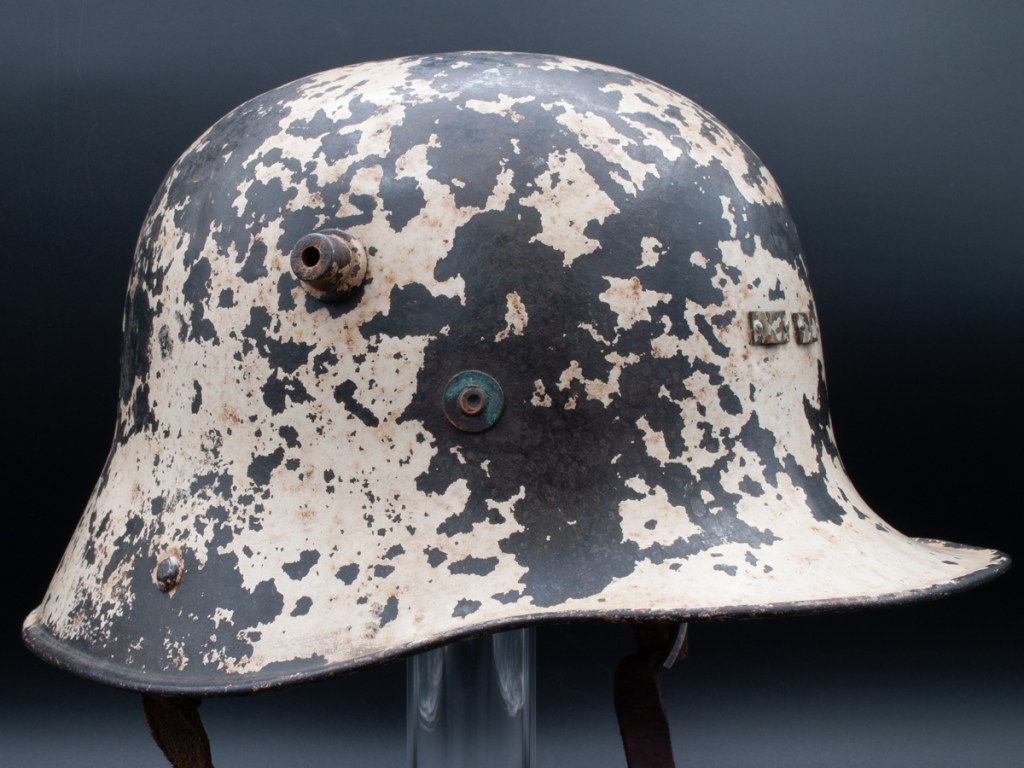
Displayed Example: I purchased this helmet from a British militaria dealer in 2023. It is in the typical ultimate configuration for this type, having been painted white for Civil Defense use. The helmet number is 7881 which places it towards the end of the total production run. Just below the manufacture and number stamp is “H40 27.” According to one source[3], these stamps were added in 1940 when the helmets were painted white and reissued. The liner band is nicely marked to “T.SMITH & SON DUBLIN 1927.” The “S” next to the manufacturer’s stamp refers to the size which would be small. The helmet size is also indicated on the shell stampings with a “-“ for small.
Collector’s Notes: The Irish M27 had a very limited production run by the standards of 20th century military helmets. According to collector lore, approximately half of these helmet were bulldozed into the ground in 1970 as partial fill for a new army barracks.[4] This makes surviving helmets all the more scarce. Although rare, these helmets surface periodically in collector markets and can be purchased for relatively moderate prices. Almost all surviving examples were painted white. Helmets circulating in their original green paint are typically formally white painted helmets from which collectors have carefully removed the second coat of paint. Occasionally, collectors will repaint these helmets as well. If somebody were to find an M27 in its original green painted configuration, you would expect it to lack the “H40 27” stamp found on the reissued helmets. The presence or absence of the reissue stamp on a green painted helmet would be an indication of whether a helmet is a reissued piece, or a formally white painted Civil Defense helmet which has had paint removed or has been painted over. An original, unrestored helmet with its factory original paint would be a rare thing to lay hands upon.
The original badges are almost always missing. Collectors sometimes use, for display purposes, Irish army officer’s cap badges that have been modified to attach to the brackets on the M27’s front. Reproduction M27 badges are also available for this purpose. The cap badges are very similar to the badges originally used on the M27s, but the two have subtle differences.
* Anonymous. Pinterest. https://www.pinterest.com/pin/797348309029800018/. Accessed March 23, 2024.
[1] Somers, J. pp.292-293
[2] Ellis, B. “Ireland M27.” Brendon’s Helmets. http://brendonshelmets.weebly.com/ireland-m27.html. Accessed March 22, 2024.
[3] Sullivan, M. “The Model 1927 Irish Free State Helmet.” https://www.frontiernet.net/~masullivan/vickers/Irish_Helmet.htm. Accessed March 22, 2024
[4] Sullivan, M. ibid





 Steel Helmets of the World Wars