
Updated: April 6, 2025
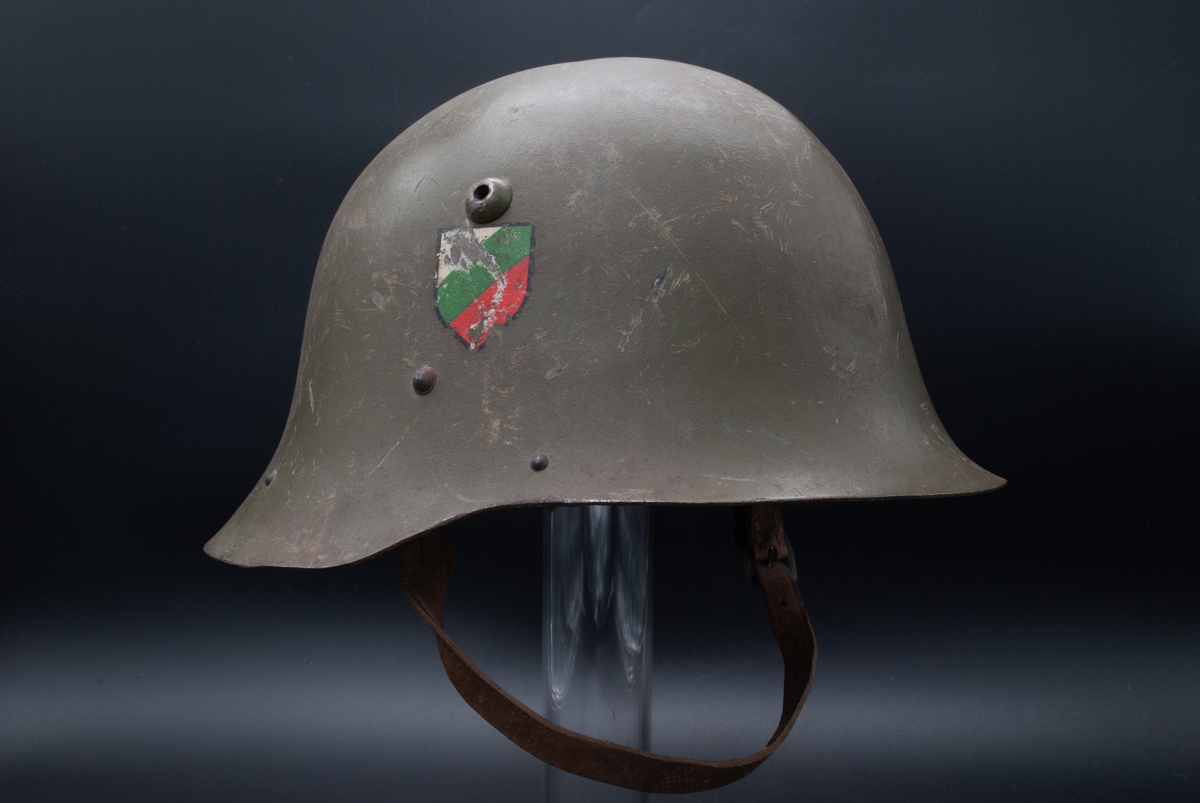
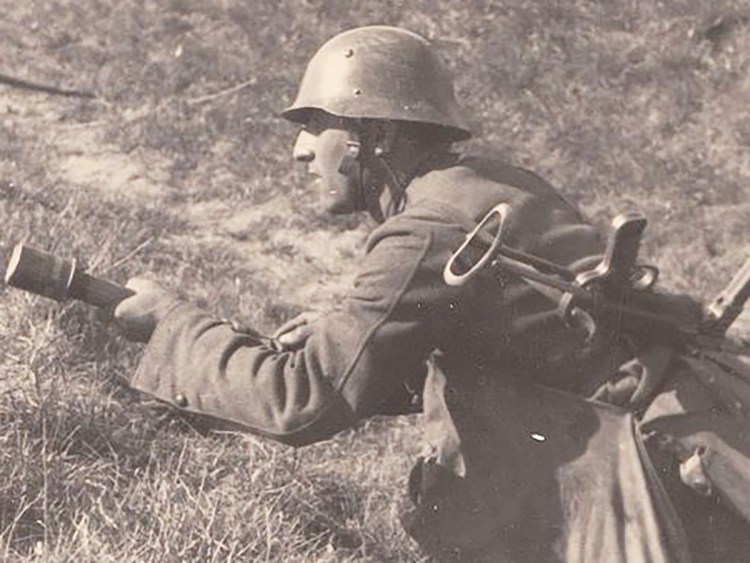
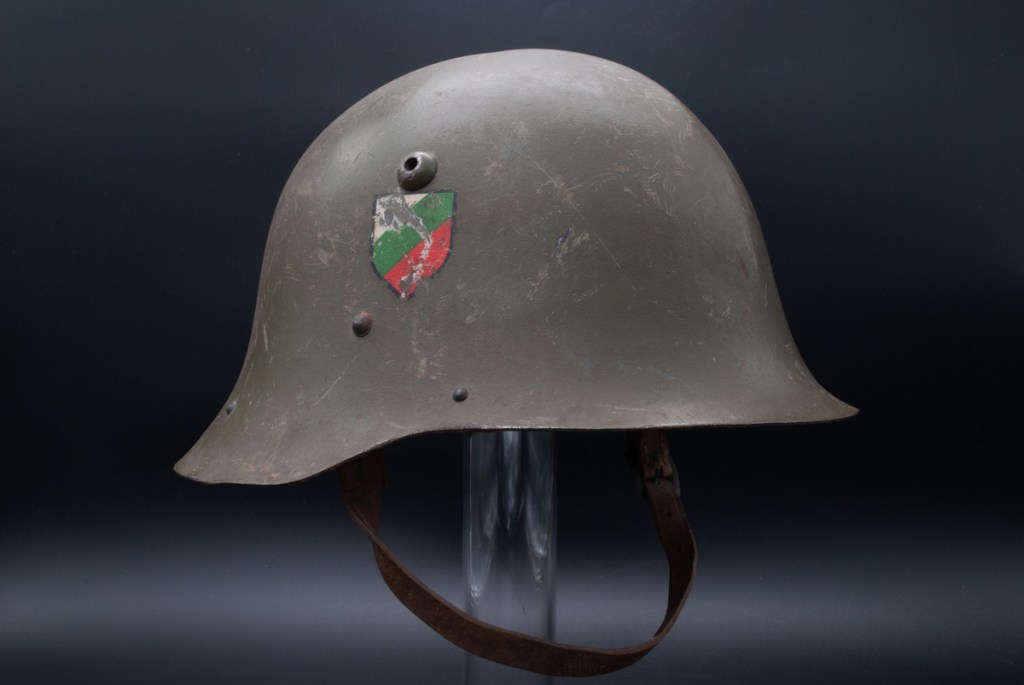
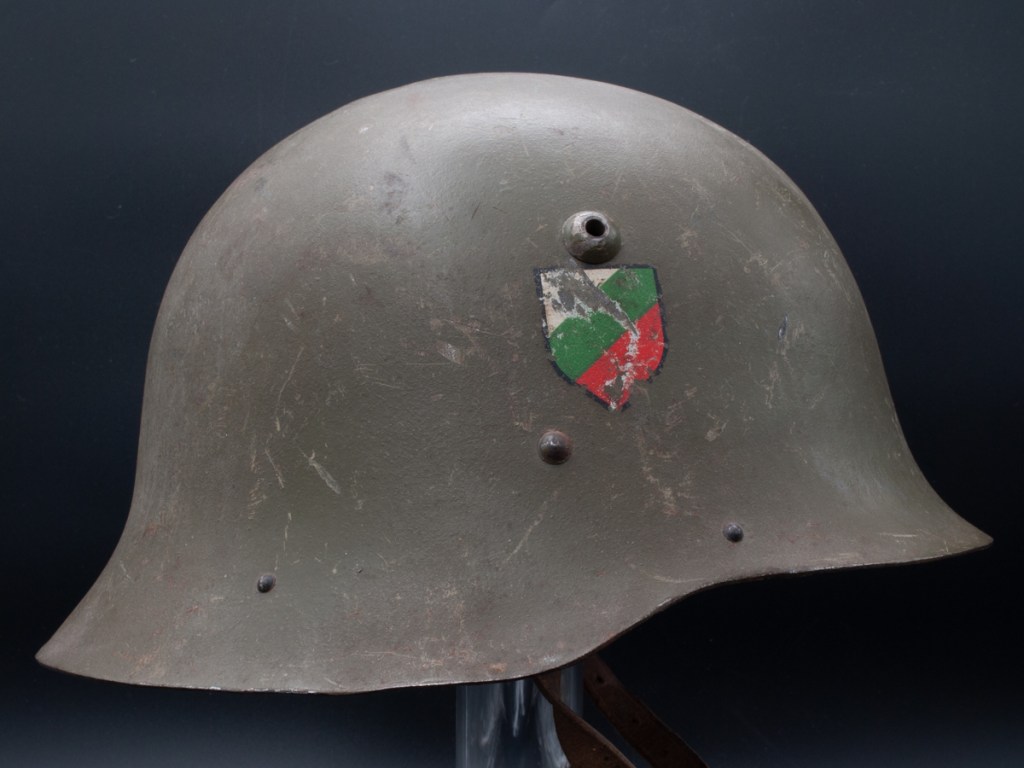
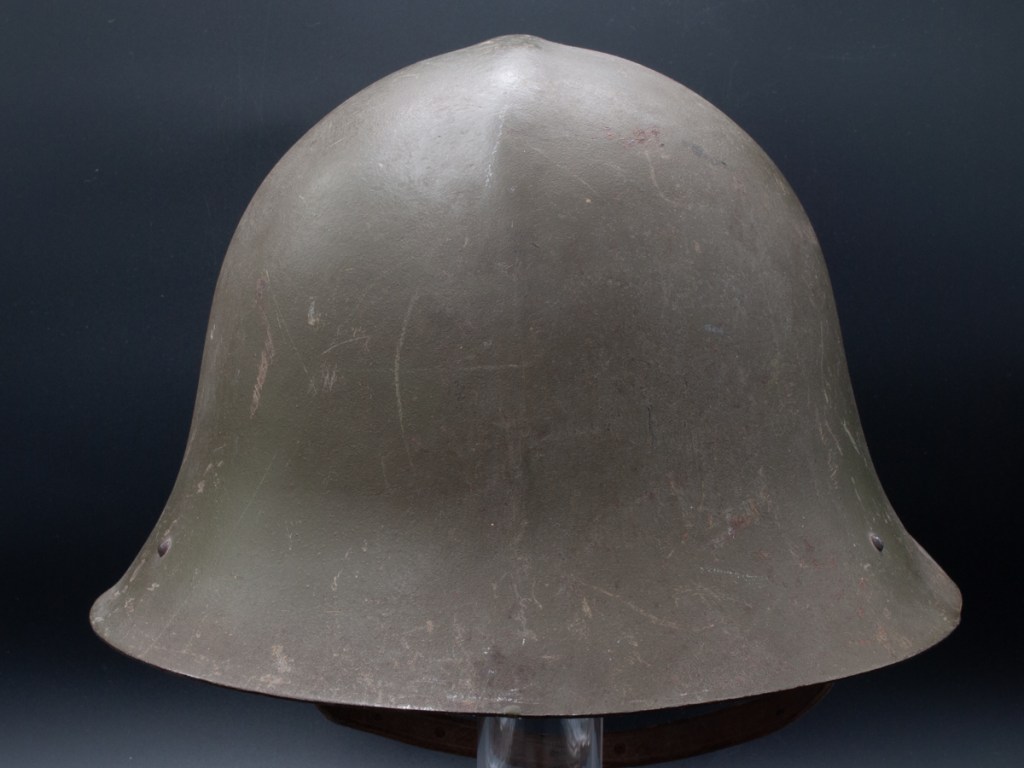
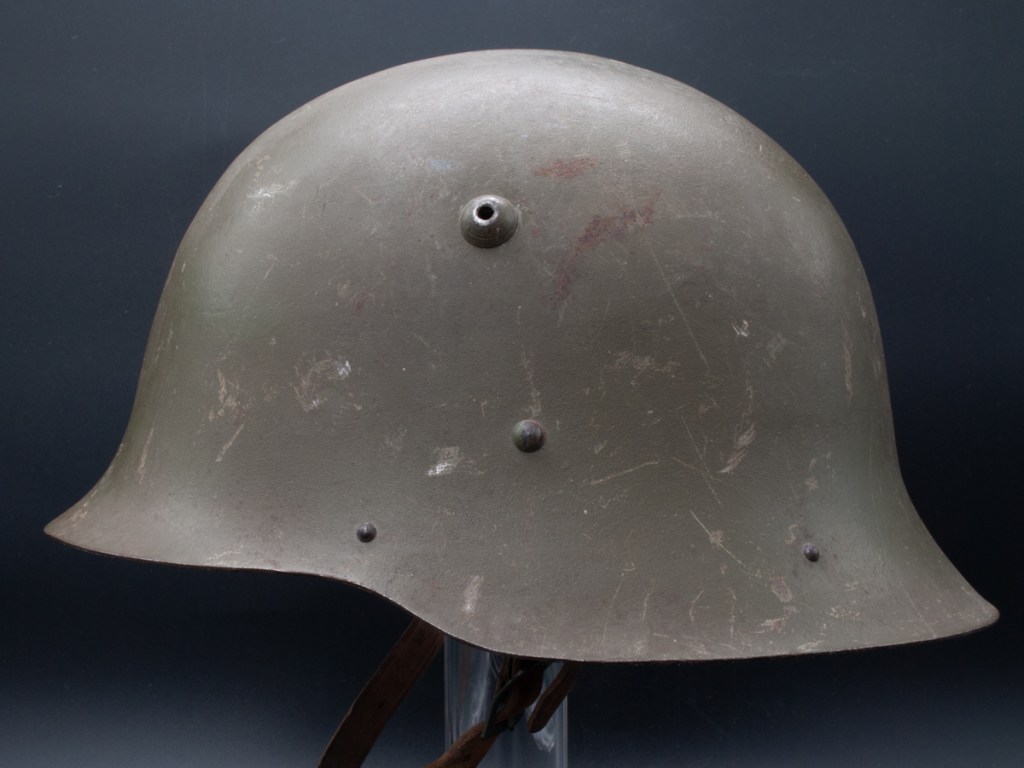
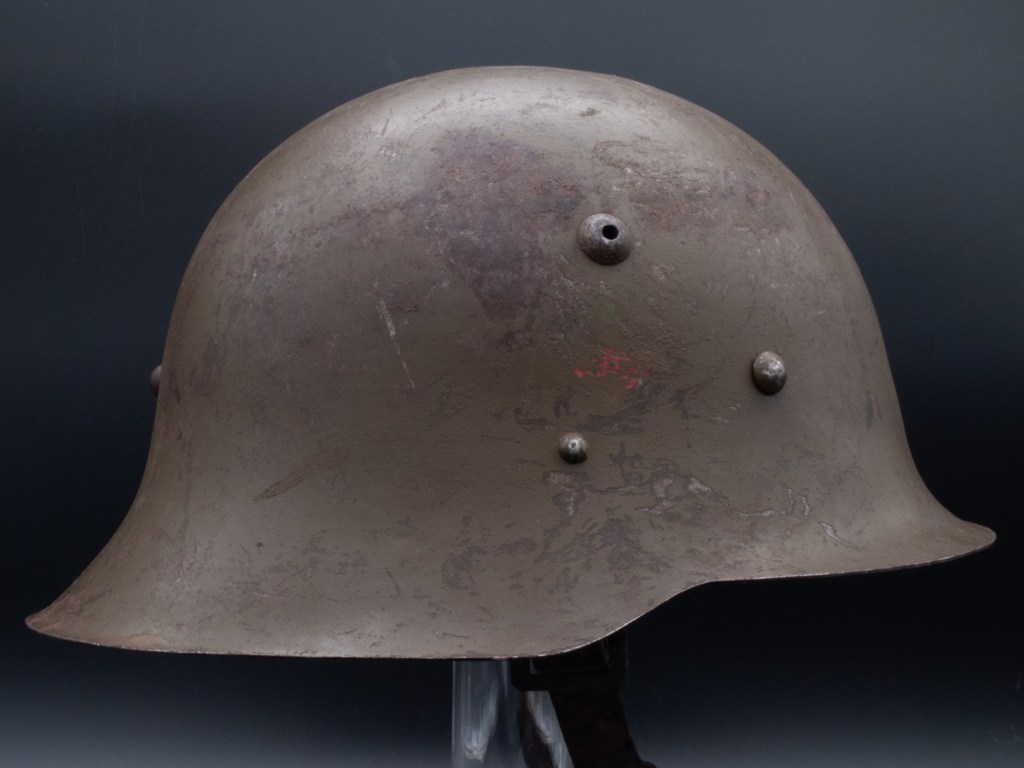
General Information: The Bulgarian Model 1936 was the helmet used by Bulgarian armed forces during the Second World War. There were three versions of the M36: A, B, and C (see gallery photos below). All followed a design like the German model from the same era but with a slightly different profile and a ridge on the top. The M36 A, sometimes referred to as the “Type-A,” had a rolled edge. Four large, round rivets held the liner in place while two smaller rivets secured the chinstrap attachment mechanism. The M36 B was like its predecessor, but it had a raw rather than rolled edge. Three rather than four large rivets secured the liner the shell. There was a less common M36B variant that used four rivets for liner attachment. The M36 C also had a raw, unrolled edge. The liners on the M36C were similar to the type used on Greek M34/39 (see Greek M34/39). This liner had a suspension system with four spring brackets that attached to the shell with four small domed rivets. The chinstrap loops were attached with medium sized domed rivets. Following the German styling, the M36s had tricolored national shield decals with the bands in a diagonal pattern enclosed in a black border on the right side. The helmets were produced in two sizes.[1]
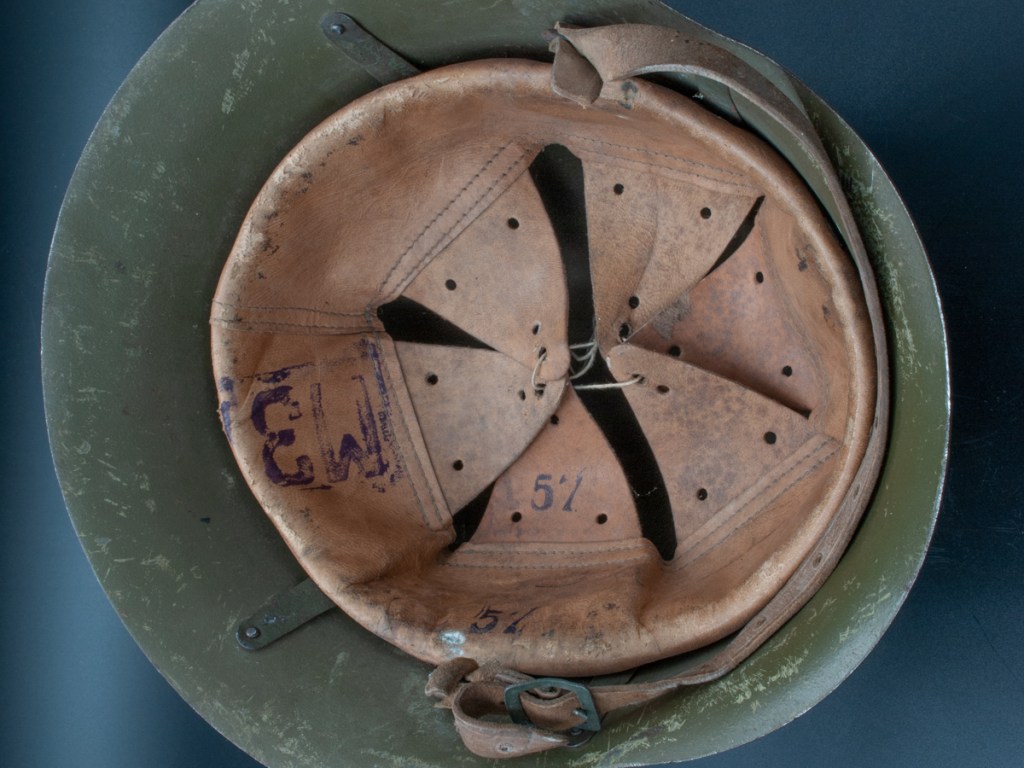
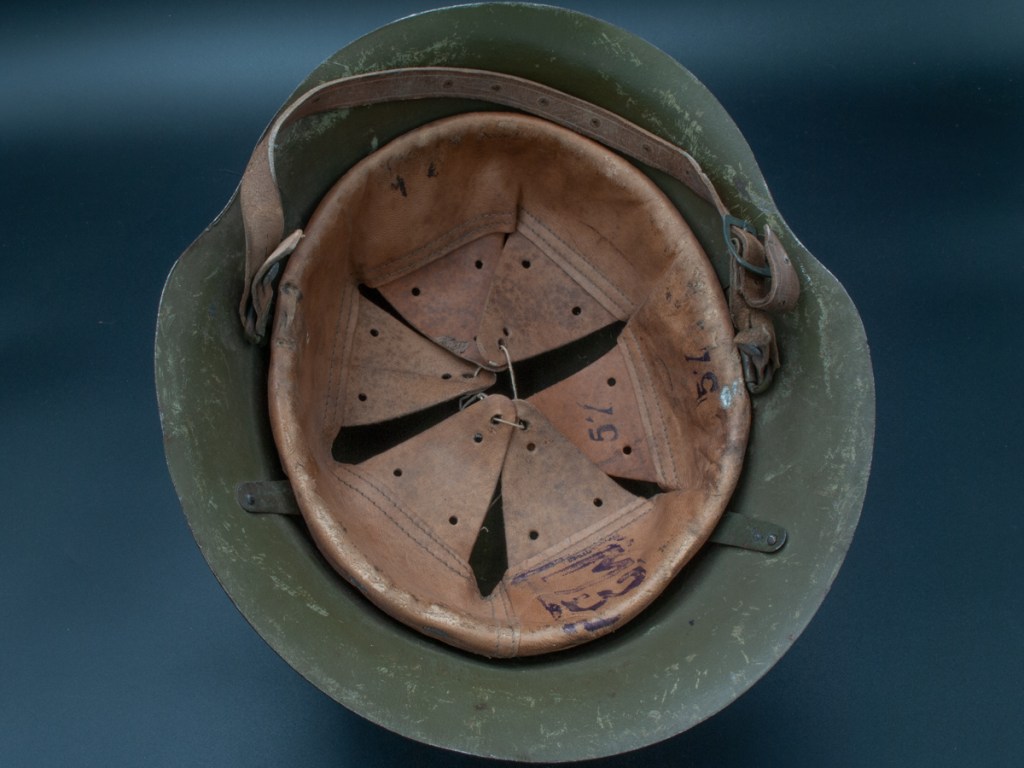
The leather liners on the M36Cs were typically made of six tongues stitched to a leather band. Unlike the M36As and early production M36Bs, the liner tongues had ventilation holes and lacked metal rings to reinforce the holes for the draw strings. The chinstraps were copies of the German WWII variety, but made thinner, lower quality leather that tended to stiffen with age. The helmets had three colored decals – white-green-red – on the right side. The Bulgarian armed forces revived the practice of displaying the Bulgarian shield in the postwar period, but with hand painted or spray-painted emblems.[2] These postwar Bulgarian national colors displays were typically painted in horizontal bands with middle band a void because background color on the helmets was green, hence no green paint was needed.
There are discrepancies in available references as to the location of the manufacturing facilities for the M36s (see the post for the Bulgarian M36A).[3] It has been generally thought, however, that the M36s were initially manufactured in three foreign factories: three foreign factories: Sandrik in Dolné Hámre and Brüder Gottlieb und Brauchbar in Brno (Bratři G&B – Brno) in Czechoslovakia and Eisenhuttenwerk in Thale, Germany. Subsequently, the M36 helmets were made in a factory in the Bulgarian town of Kazanlak using presses imported from Germany.[4] It seems clear, based on available references and forensic analysis (e.g., Czechoslovakian type domed liner split pins and Czechoslovakian patterned chinstraps) that the M36As were made in Czechoslovakia. My personal conclusion after reviewing all available material on the subject and consulting with several knowledgeable collectors is that the M36As were made in Czechoslovakia and that the M36Cs were made in Bulgaria at the state military arsenal in Kazanlak. It is also possible that some M36As were manufactured in Bulgaria.[5] There is not much information available about the M36Bs, but it seems likely that these were made in Bulgaria[6] and possibly in Czechoslovakia as well. The idea that some M36s were made in Germany is not supported by forensic evidence, meaning that there are no M36 helmets that have Eisenhuttenwerk stamps or some other feature that would indicate that they came were made by this company. To date I have not found convincing documentation to support the German provenance of M36s, so I suspect that this may be a collector myth.
The M36s of all types were refurbished locally both before and after the war using a variety of materials and styles. There seem to be two ‘official’ rounds of refurbishment that were likely conducted in the state armory in Kazanlak. Helmets from these rounds of refurbishment followed a standardized form. The first round of factory refurbishment was likely accomplished in the 1970s and the second sometime probably in the 1980s. In both cases, all leather parts were removed and the shells were stripped to bare metal before being repainted. In the first round the liners were made from reddish brown leather, usually using two pieces. Between the leather and the liner bands there was a grey to brown color woolen or felt material which provided cushioning. These helmets were painted with a uniform greenish mustard color. In the second round, the liners were similar but made from a pale reddish leather and with white backing material for cushioning. The liner size was indicated by an ink stamp. Another ink stamp present on these helmets bears the initials “OTKK” within a small circle. This may represent the maker of the liners. The straps were made of reddish leather and tend to stiffen with age like the wartime straps. The helmets were painted in a uniform greenish color that was darker than the earlier refurbished ones. Helmets from this last round of factory refurbishment are usually found in unissued condition and without any insignia whereas the helmets from the first round of factory refurbishment often have insignia, typically painted national shields and other signs of issue such as the owner’s name.
Prior to these two rounds of factory refurbishments, the repairs were carried out at the unit level using various materials and incorporating various styles. These are readily spotted by a second coat of paint and the absence of national color shield decals. They frequently have red painted communist star emblems on their fronts.
Displayed Example: I was at a dealer table at a Show of Shows in Louisville, Kentucky watching the dealer pull stuff out of a box. He pulled out this M36C helmet and passed it to me. I gave him his asking price of $45 and added this specimen to my collection. It is complete and, in its WWII factory, original condition. This size is nicely marked twice on the liner: 57. There is a large “M3” ink stamp on the liner, which stands for Мирновременен Запас – Peacetime Stock.[7] Apparently, the Bulgarian armed forces applied these commonly seen stamps to the M36 helmets before putting them into storage after the war.
Collector Notes: The Bulgarian M36 may be the longest serving World War II helmet. According to one Wikipedia source[8], the M36C was still in service in the 2010s, although it was being phased out. Of the three types, the M36C was the most common, accounting for 70% of all production.[9] [10] As my SOS story illustrates, this helmet type can be had for near army surplus prices. It is one of the most affordable additions to a WWII helmet collection. Because of their long service history, many of these helmets were refurbished postwar. Unlike the M36As and M36Bs, however, it is not very difficult to find a M36C in its factory original WWII configuration. You just have to know what to look for.
* Photograph courtesy of Mannie Gentile. “Bulgarian M36/C combat helmet.” Mannie Gentile: Combat Helmets of the 20th Century. March 30, 2017. https://combathelmets.blogspot.com/2017/03/bulgarian-m36c-combat-helmet.html. Accessed February 20, 2025.
[1] Jacobs, Walter. Personal communication. March 16, 2025
[2] Muhovski, Teodor. Bulgarian Helmets. 2004. https://web.archive.org/web/20170311132509/http://helmet.0catch.com/m36.htm. Accessed February 20, 2025.
[3] The Wikipedia entry cited in the footnotes here does not indicate which models were produced where. In Paulo Marzetti’s book “Elmetti” he wrote that M36A was produced in Brno, Czechoslovakia, and that the M36B and M36C were produced in Germany at the Eisenhuttenwerk factory in Thale (Marzetti, Paolo. 2003. pp52-54). In the book “Tin Hats to Composite Helmets” (Brayley, Martin J. 2008. pp22-23) it states that the M36As were made in Czechoslovakia, the M36Bs in Germany, and the M36Cs in Bulgaria. On a now defunct Bulgarian website called “Bulgarian Helmets” (Bulgarian Helmets. 2004. https://web.archive.org/web/20071020110602/http://kaski.boinaslava.net/m36.htm#. Accessed February 20, 2025.) it provides the same information as the Wikipedia entry regarding the three foreign companies that manufactured the M36s and cites Marzetti’s research as the source of the information about the Eisenhuttenwerk production. Marzetti, in turn, cites an old German weekly publication, Die Woche, (Marzetti, Paolo. 2023. pp52 [no issue number or date is given]) as the source of his information. In “Les Casques de Combat: Tome 2” the author of the chapter on Bulgarian helmets states that the M36s were designed and manufactured in Czechoslovakia and also produced in Germany at the Eisenhuttenwerk factory, but the citation for Eisenhuttenwerk claim is unclear and it does not clearly specify which models were produced where, although it seems to suggest that the German made helmets were the M36As. One researcher who has tried to confirm the Eisenhuttenwerk production of M36s keeps coming up with dead ends following available citations and scouring other reference sources. He has come to suspect that the idea that some M36s were made in Germany may be a case of people repeating misinformation.( Prokhorov, Pavel. Personal communication. February 9, 2025.)
[4] “Bulgarian M36 helmet.” Wikipedia. https://en.wikipedia.org/wiki/Bulgarian_M36_helmet. Last edited June 5, 2021. Accessed July 10, 2022.
[5] Jacobs, Walter. Personal communication.
[6] Jacobs, Walter. Personal communication.
[7] Alex. Personal Communication. July 8, 2024.
[8] Ibid “Bulgarian M36 helmet.”
[9] Ibid “Bulgarian M36 helmet.”
[10] Ibid Bulgarian Helmets. (This source says that 60-70% of the M36s were M36Cs)





 Steel Helmets of the World Wars
МЗ stands for Мирновременен Запас – Peacetime Stock.
LikeLike
Hi Alex, Sorry for taking so long to get back to you. I really appreciate this helpful information. I had wondered about the M3 stamp. I’ve made an adjustment to the post accordingly. I’ve cited you as the source, but only have your first name (see footnote #2). If you’d like to provide your last name, I can add that to the citation.
I’m looking for a best quality period photograph of a Bulgarian M36C in use in case you’re able to help me with that.
Cheers,
Mark Dillenbeck
LikeLike